ANNA POPOVA WENT LOOKING FOR UKRAINE AND FOUND HERSELF
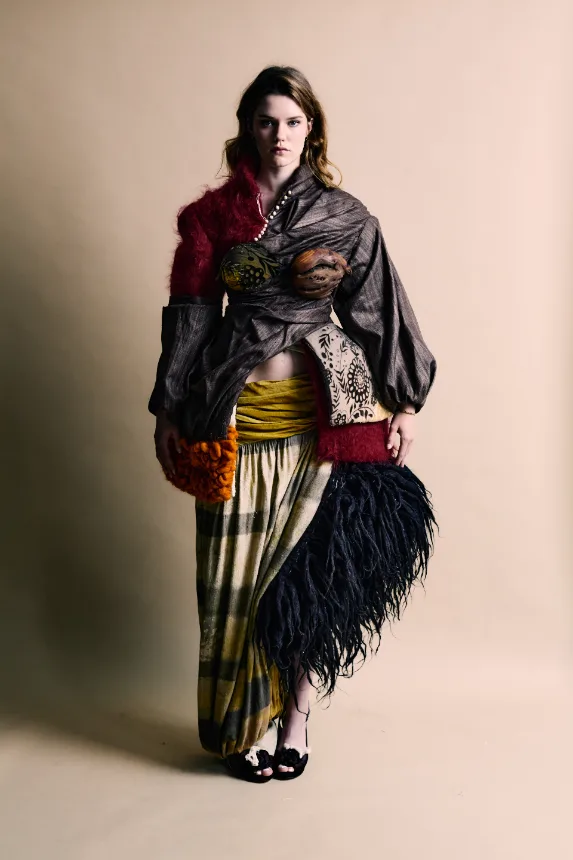
Ukrainian designer Anna Popova has stopped reaching for Western references and turned to the village her Grandmother watched disappear, fueling inspiration for her final collection from Central Saint Martins, Bakota.
For most of her time at Central Saint Martins, Anna Popova looked west. The references came from popular Western culture, and the artists inspiring her were of the Western canon; she knew, even then, that she was reaching for what was nearest to hand. "In my first and second year I relied a lot on Western artists, because I was taking the easy way out," she says. "I thought Ukraine didn't have enough for me to fully dive into. I was completely wrong."
Over a phone call — at a time when Popova was struggling to come up with the premise of her collection — her grandmother, in Ukraine, mentioned a place she had once lived, Bakota (Бакота), a village condemned under Soviet rule to vanish beneath the waters of a new dam, Dniester Hydroelectric, in 1981. What was left to its residents was hardly a decision at all. "They either had to destroy their buildings and get some money, or do nothing and get nothing," Popova tells me. The townspeople were forced to take down their own homes before the water came. "One of them said the hardest part of destroying your own house was the garden and the trees because that's where the meaning of their life was." The story stayed with her and, in her words, "shaped the emotional foundation of this work."
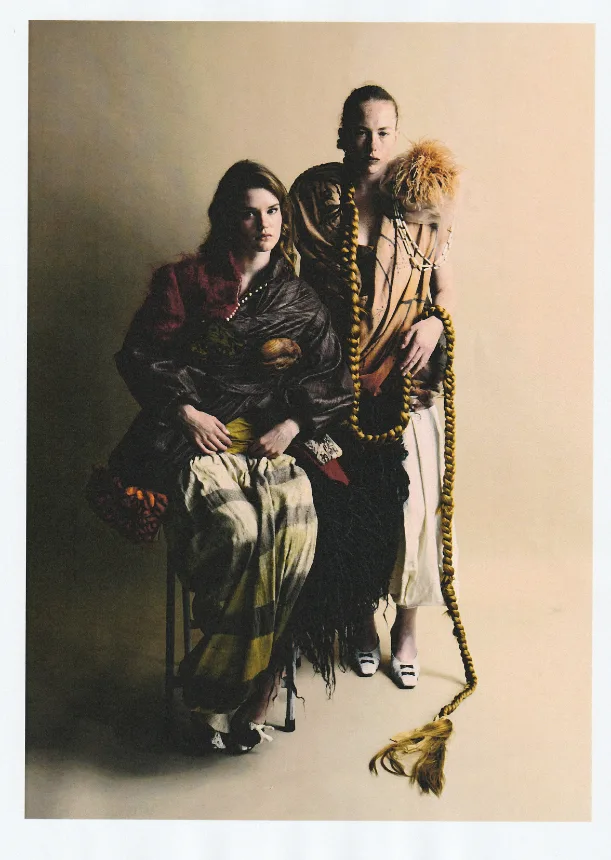
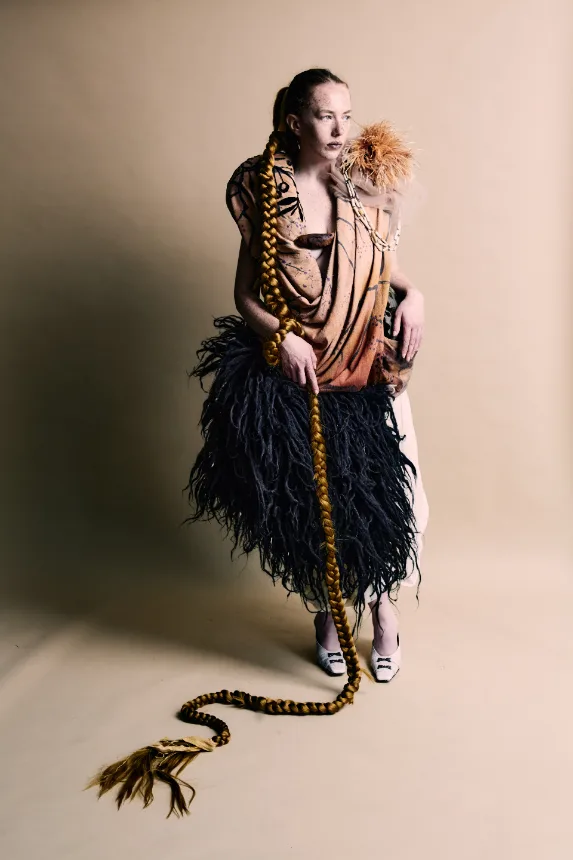
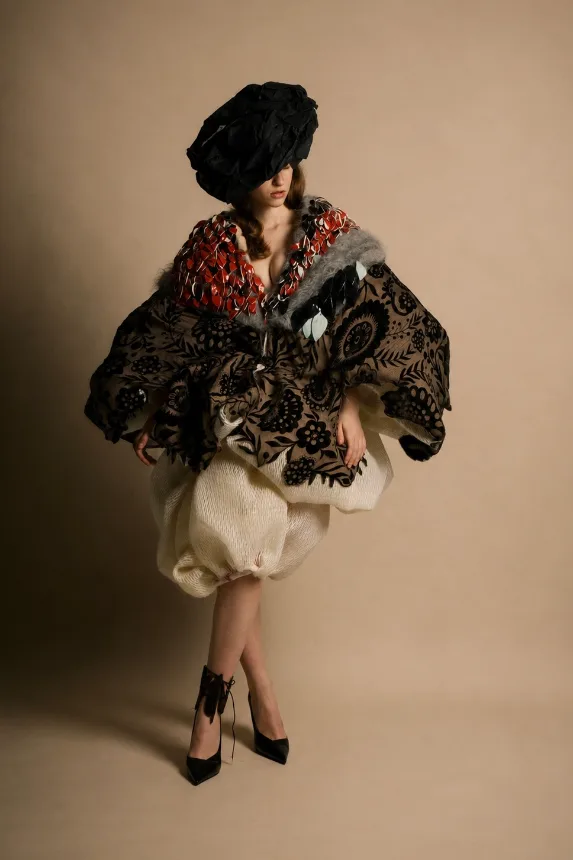
What survived the flood is a cave monastery, now filled with various artworks and graffiti, and what Popova has built from it is five looks that treat the place as both alive and lost. "It's a land erased by human invention," she tells me over FaceTime, late into the night, "but it continues to exist through memory, silence, and spiritual resonance." She's 22, and talks about the village as if she'd lived there her whole life.
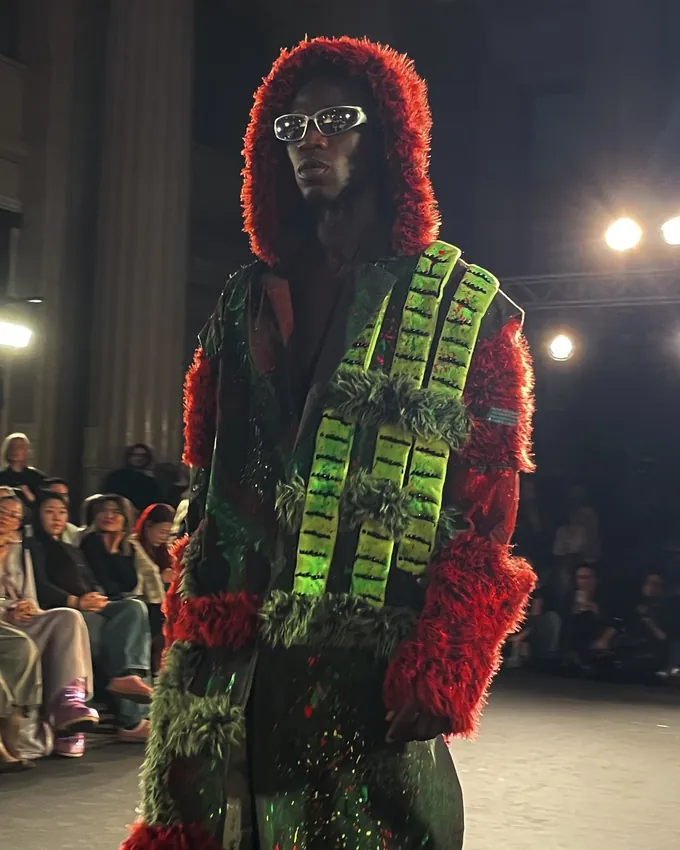
The collection has an earlier starting point than the phone call, though. Before her grandmother uttered the word Bakota, Popova had spent the summer in Ukraine, interning at Gushka (Ґушка), a wool brand in the Carpathians that makes carpets and coats using traditional weaving methods. "Their philosophy really stood out to me. It's basically about making traditional Ukrainian techniques last," she says. This is the premise of her collection in its entirety: to explore the cultural techniques of her homeland and carry them forward, something especially reverent in today's climate.
The wool there comes out hairy and voluminous, almost spiky, and only gets that way through one process, called valylo (валило), the water-powered fulling still used in the Hutsul region the brand works in. After the cloth is woven, it is placed in a wooden structure built around running water. "I couldn't do it in a washing machine," she says. "It would just break. It's this really old, traditional structure that makes the magic happen."
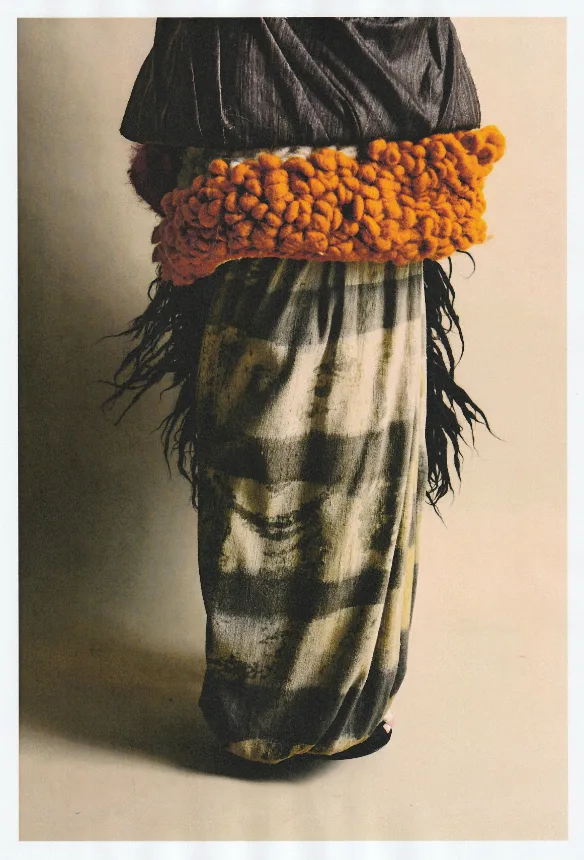
In Kosiv (Косів), the village where she traced the weaving back to, it isn't a craft so much as something people are born into. "If I'd been born there, I'd have a weaving rack at home, and I'd probably already know how to do it," she says. What struck her was the feeling in the work. "I haven't seen wool treated anywhere else the way they treat it in Ukraine. They love it more. They put more time into it."
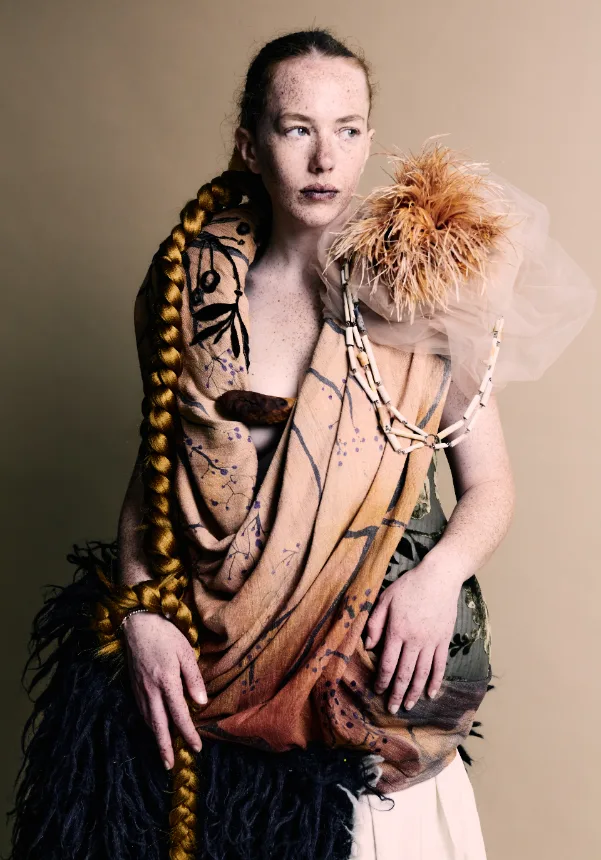
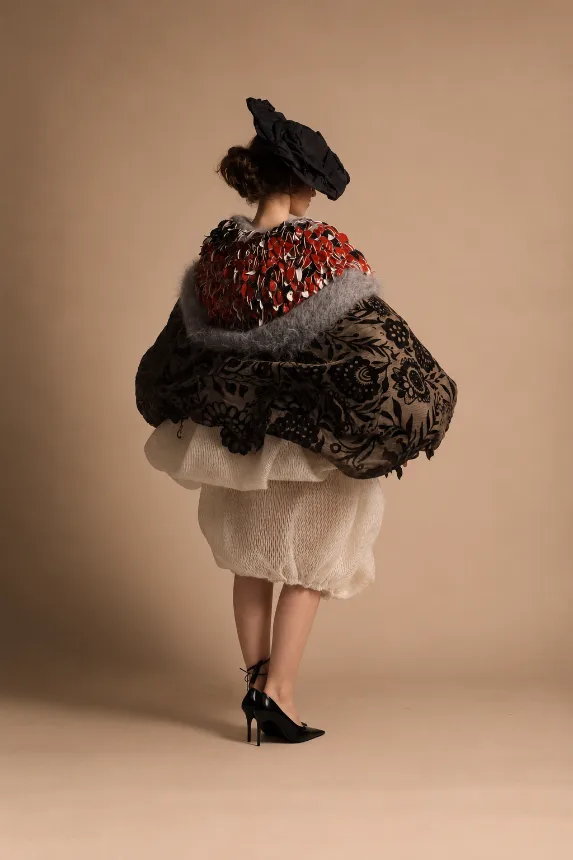
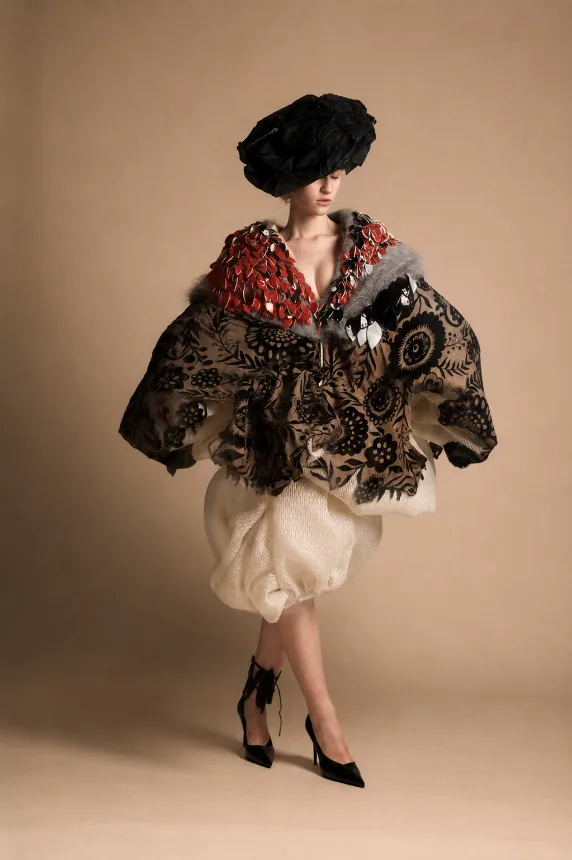
Each of the five looks is an archetype, drawn from Ukrainian folklore and made, as far as she could manage it, by hand. "A lot of the things I learned during the making of this collection, I learned for the first time," Popova explains. The first look is the Scythian Baba, built around the stone figures that have been found in the steppe for centuries. The idea was born out of a poem by Lina Kostenko that Popova read while undergoing her research process, in which a man stands before one of the figures and speaks to her, struck that she has outlasted everything around her. "She's been there so long and hasn't changed," Popova says, recounting it. "The world is changing, there are aeroplanes, and she's still there." Then the figure answers him. "She laughs at him and says, I'm here forever, no matter what. But you will change, and you will go."
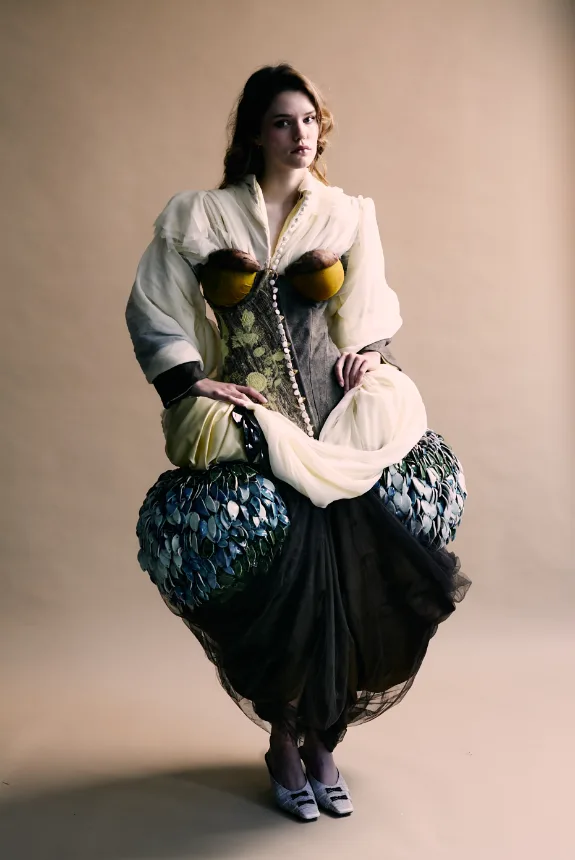
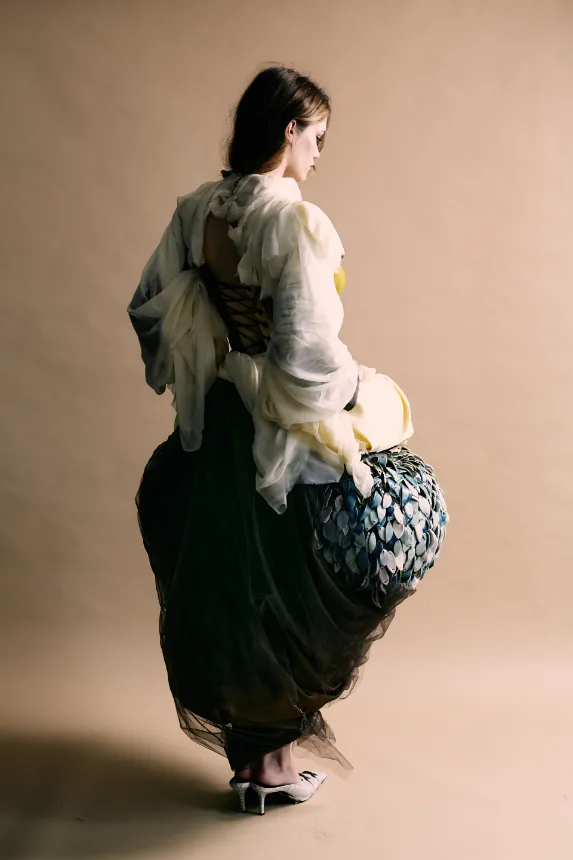
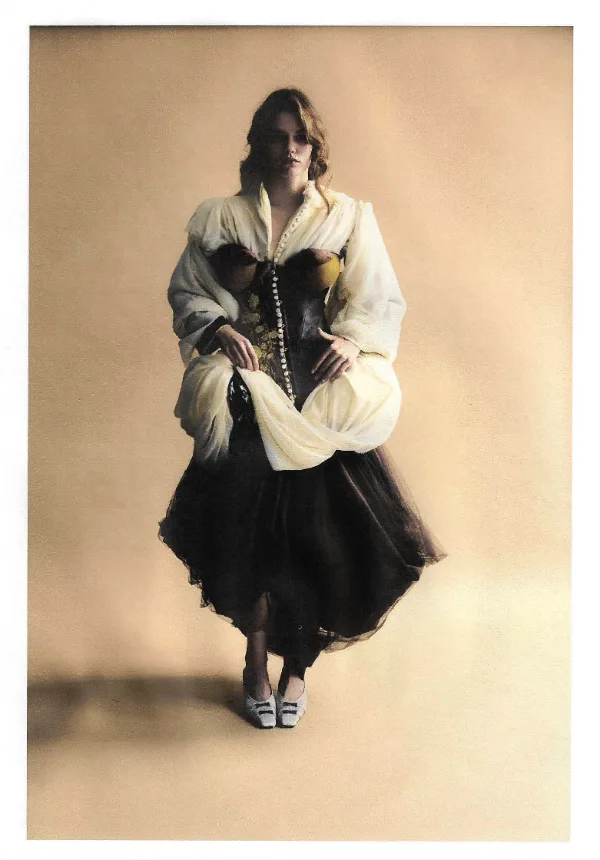
She pushed the reference further back, into Trypillia, the ancient civilisation excavated on Ukrainian land, walking the earth before the Greeks or the Egyptians. Its clay figures were household talismans, for fertility and birth, and Popova rebuilt them at scale. Two spheres of ceramic leaves sit on the hips, carved and fired by hand with her mother from November onwards. What's more, they aren't fixed. "It's not only beautiful, but it's also functional," she says. "You can take the spheres off, and it's a whole new outfit." She'd never worked with ceramic before. She mentions that clay is everywhere in Ukraine, and that she saw a lot of it in Kosiv, and thinks it worked on her without her noticing.
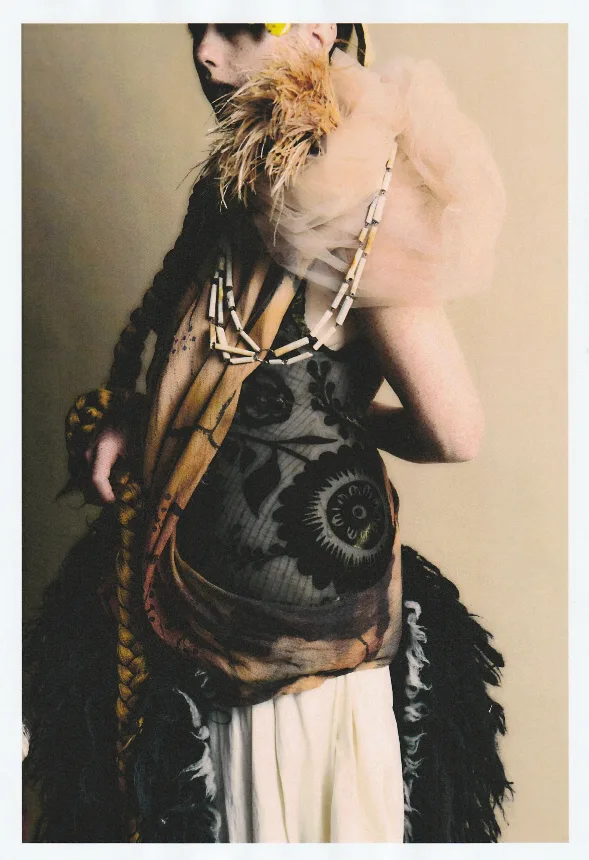
Most of the collection went like that, a technique she didn't know, learned in the year she needed it. The look she calls Labyrinth has a crinoline cage underneath, a skeleton she built first to hold the volume, and velvet on top that she burned by hand. The technique is called dévoré, where acid eats part of the cloth and leaves the pattern standing. "Velvet is two compositions, viscose and silk," she says. "What's left underneath is the silk, and what didn't burn on top is the velvet, the black flowers." The research behind it started with the churches the Soviets destroyed, and the cave shrine at Bakota that outlasted the flood. "Every place meant for people to come and pray was destroyed," she says. "It was illegal to believe."
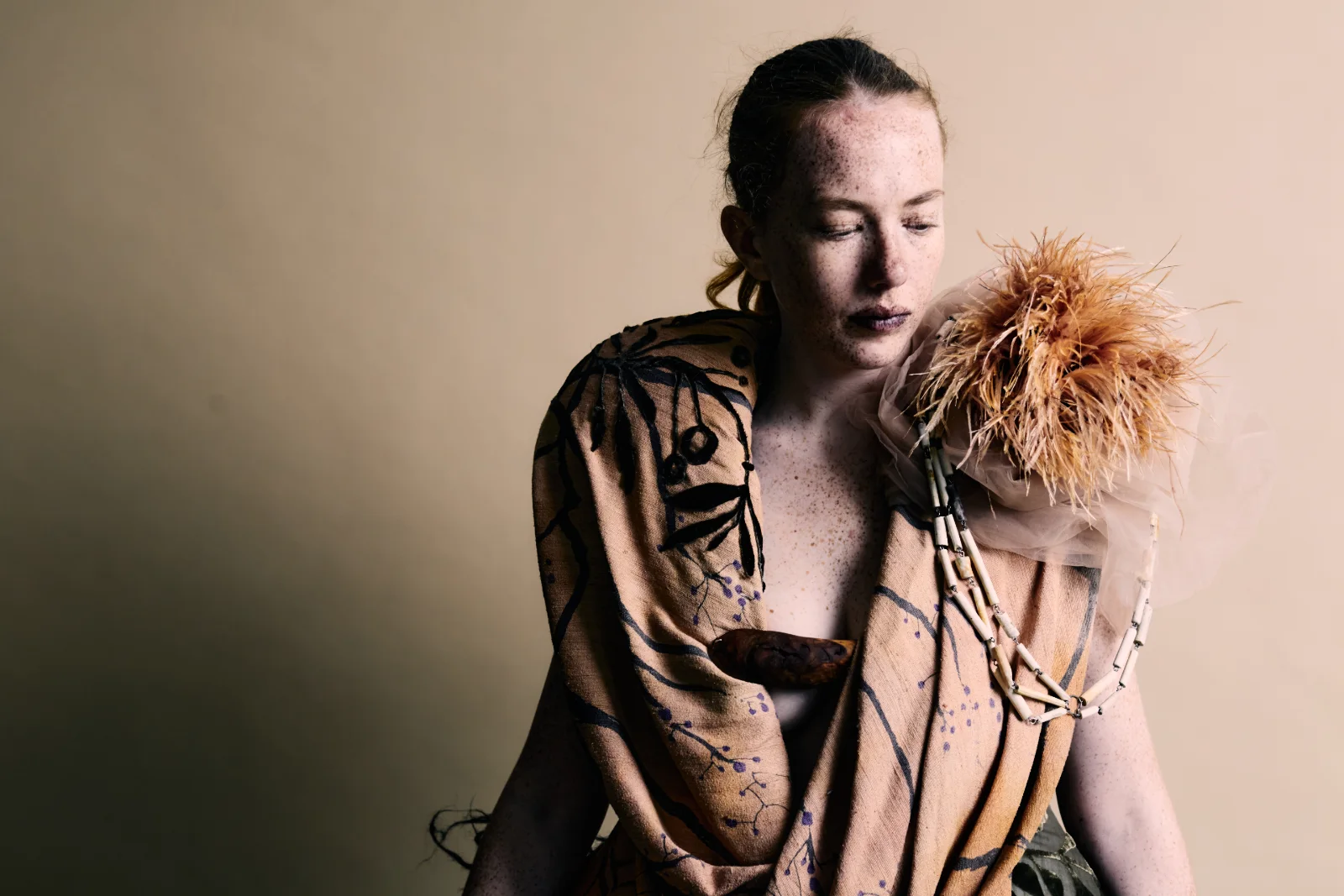
After four looks weighted with absence, she wanted one that wasn't. The fourth is a bird, after Maria Prymachenko, whose painted animals are bright and invented, and unbothered by realism. "For me, a bird represents freedom, joy, hope. I wanted to show that pain is not all that we have," she says. The print on it is hand-painted with dyes she made from berries and onions, then screen-printed with branches. "I put my headphones on, got into that space and started drawing, and it came out," says Popova.
The last look is titled Mamai, named for the Cossack figure of protection. She frames it as the resolution of the whole sequence. "It all progresses from origin to transformation," she says. "This final stage proposes continuity rather than closure, identity evolving through remembering rather than forgetting."
That way of working, feeling it out rather than planning it, is how she thinks the collection should have been made, and how she sees Ukrainian art more broadly. "A lot of this is led by the heart, and I feel like a lot of Ukrainian art is also led by the heart, by openness," she says. Even turning toward Ukraine in the first place took convincing. She went to the British Library half-expecting to come back with nothing. "There were ancient books I looked up thinking there's no way they'd have them," she says. "And they had them."
Bakota was emptied long before this war, but the impulse behind it never really left. Popova has made this collection in the fourth year of Russia's invasion of her homeland, while the same logic that drowned her grandmother's village plays out again at a national scale, not only the taking of land but the slow attempt to unwrite a people, to dissolve a culture into someone else's and call it the same thing. It is a war on memory as much as on territory, and memory is the one thing Popova has spent a year refusing to give up.
What moved me, listening to her, was how little of this she framed as politics. She talked about her grandmother. About a place she had never seen that she somehow carried anyway. About the hours with her mother and the clay, the things she taught herself because no one was going to teach her, the way a country can live inside a person even after living elsewhere for so long. By the end she wasn't really describing a collection. She was describing a way of carrying something forward, of keeping a heritage in her own hands rather than letting anyone else decide what it means.
"We're still fighting to separate ourselves from that culture," she says, meaning Russia's. "They're still using propaganda to erase our identity." She says it plainly, the way you say a thing you have known your whole life. A young Ukrainian designer, making her culture with her own hands, learning who she is.
"I wanted the beginning of my journey to be based on who I am and where I'm from," she says. "It was important to learn more, not just about Ukraine, but about myself."