10 DESIGNERS TO KNOW FROM LJUBLJANA FASHION WEEK
After four nights on the front row in Slovenia's capital, Gabriel Winter kept coming back to the same 10 names long after the lights went up. Discover the talent below.
Every few seasons, the fashion press settles on a new city to be excited about, and carries that excitement forward. Copenhagen has its moment and keeps gaining traction; then Tbilisi, and more recently Kyiv and Warsaw, have been passed around the front rows as places to watch, each with its own story of a local scene finding an international audience. Ljubljana has been building towards that moment for some time now.
Its fashion week has grown into the main meeting point for designers across Slovenia and its neighbours; its graduates increasingly turn up in studios and on schedules further west, and over the past year, it has started taking its designers abroad, most recently to a showcase during Berlin Fashion Week.
People who follow fashion in this part of Europe already know the names, and now the city's designers deserve a wider global audience.
Much of the week's character comes from how it is made. Ljubljana Fashion Week is funded almost entirely by the people who run it, and its designers are still campaigning for a Slovenian Fashion Council to support them. They work for a home audience that knows them well enough to fill the room with former tutors, fellow designers and proud parents filming from the sidelines. This is the closeness that these larger weeks lack.
Across four evenings of SS27 shows, the creatives who stayed with me drew most openly on their own lives. One swam competitively for eight years and printed the tiles of the pools she once raced in onto the clothing she showed, while another worked through her love of kitsch, Sailor Moon, and the Balkan pop of her teenage years with a sense of humour that had the whole room moving in their seats.
Because the scale keeps everyone within reach, most of the conversations below happened backstage within minutes of each show ending, among the rails and half-packed bags while the room was still moving on to the next event. I saw far more over the four nights than I can write about here, but what follows is the week narrowed down to the designers I kept returning to once I was home. A few from each evening, in the order I saw them, and each of them is a name worth knowing and talking about overseas.
DAY ONE
ÆMONA
ÆMONA takes its name from Emona, the Roman settlement that stood on the banks of the Ljubljanica long before the city around it had a name of its own. That sense of digging into what lies underneath has run through the label's work for several seasons now, with collections that pair sharp, structured tailoring with fluid, draped silhouettes and oversized coats with delicate dresses. Previous collections mostly worked in black and white, broken by flashes of crimson and gold, and the label has built its production around low-waste methods from the start.
This season, Creative Director and Founder Anika Opara turned to the moonwalk, highlighting the question on her lips. "In what ways are we seemingly moving forward while actually going backwards?" Models walked the runway, pausing once to moonwalk backwards in heels before stopping abruptly and returning to their forward strut, cleverly tying this notion into the presentation and the pieces.
Red lips, fierce side cutouts, belted garters, and hoop bags tucked tightly under the arm defined ÆMONA's SS27 collection, one finalised around an ongoing pregnancy and recent engagement. Is there anything Opara cannot do?
SANIJA REJA ASKE X SOFIA NOGARD
Sanija Reja grew up in Goriška Brda, the wine country on Slovenia’s border with Italy, and holds a special place in Ljubljana Fashion Week's history as the first designer to win its WOW award. Her label, SANIJA REJA ASKE, has always treated each collection as a story or a fairytale, with magical, sometimes very funny clothes made for people who have no interest in blending into a crowd.
This season, she joined forces with Mija Curk, whose label, Sofianogard, makes small runs of bags and dresses built to be mixed and matched over years. Their joint collection, Morana, is named after the old Slavic goddess of winter and death, who also governs the cycle that brings rebirth after both. Featuring reds, tartans, greys, blacks, and cable necklaces, it was a darker, more romantic turn than her earlier work, setting femininity against strength and tenderness against decay.
Reja’s clothes shared the runway with Curk’s accessories, and the pairing made the collection feel like the work of a single, very gothic imagination.
MORJA
MORJA is Zala Hrastar's label, and its name, meaning “of the sea” in Slovene, suits clothes that seem to have washed up from somewhere else, with a history already attached. Hrastar works almost entirely in second-hand and vintage textiles, patching them into colourful garments that carry the folk-inspired, slightly poetic visual world the label is known for. She studied on exchange at Design School Kolding in Denmark and spent time at the Stockholm label Rave Review, whose approach to remaking old fabric has clearly stayed with her.
For SS27, she invented a place for her clothes to come from. Rosenlund, as the collection is called, is an imagined valley of wildflowers and forests “beyond nine mountains and nine waters,” as the Slovene fairytale phrase has it. Its inhabitants waste nothing, repair what is broken, remake old things into new ones, and each wears a crown of their own. The floral-crown headpieces and patchwork that came down the runway looked like souvenirs from that valley, and the collection made as gentle and persuasive a case for slow fashion as anything I saw all week.
DAY TWO
SARIVALENCI
Sara Valenci’s label SARIVALENCI sits somewhere between reality and fantasy, and her collection FU FU Diamonds took everything most people would be embarrassed to own and wore it with total conviction. Backstage, she told me it started from her love of “tackiness and kitsch and pink,” and from a particular kind of modern girl who can “throw on the fake Birkin and be more popular than the one that has the real one.” The collection was built on grey jersey, the fabric of tracksuits and Sunday afternoons, with lingerie printed on it as a flat, two-dimensional illusion and, here and there, spikes rising from the soft cotton. The proportions were pulled out of shape so the legs looked startlingly short, and the hair was fake too, finished with clip-in plastic fringes in the style of anime characters. “Everything is really fake, but really making it work,” she said, explaining that the idea came from watching “how young people can take something really plastic and ugly and make it the trend.”
The references went back to her childhood, with Sailor Moon, which she called “my ultimate cartoon,” appearing in the opening look. The soundtrack drew on Colonia, the Croatian pop group whose songs filled her teenage years, with the vocals stripped out to leave only the beat. The audience half-recognised each track as it came on, and I had to explain to myself what everyone around me already knew, having grown up nowhere near the Balkans. “I wanted everything that’s ugly to make it cool and hip and trendy,” she said, and the show managed it while staying, in her words, “out there, but not out there.”
PETJA ZOREC
Petja Zorec designs voluminous, genderless clothes that start from sport and from the contradictions she finds in it. Her label describes the territory as serious humour, sweet bitterness and frozen movement, which gives a fair idea of how she works. This season’s collection, Chlorine 2028, is built around an imagined swimmer called Chlorine, who is training for the 200m breaststroke at the Los Angeles Olympics. Chlorine’s body and mind have been shaped by the daily grind of the pool, and her sense of beauty has been formed by the shifting picture of the world as it comes in and out of focus through the water.
The character turned out to be closer to the designer than I had realised. “I was a professional swimmer,” Zorec told me backstage. “I was training swimming for eight years.” The collection starts at the moment of diving in and “the view that you have with your glasses on, the view under the water.” It moves through the tiles of the pools she raced in, which changed from venue to venue “because we went to different locations when we had contests, so the pools were so much different,” and it ends with the feeling of “the water that goes around your body.”
You could see all of it in the clothes. One brown top, worn with darker trousers, was printed with what looked like pool tiles broken up by moving water. Archive photographs of Zorec swimming, along with pictures taken by a grandfather whose habit of reaching for the camera once embarrassed her, were printed directly onto several pieces. A top marked with the letters LST turned out to be an upcycled hybrid of two swimsuits, one she still swims in and one from a second-hand shop. The trousers I had confidently taken for paper were in fact a textured fabric bought already in that shape, which we agreed was probably for the best, given how long paper would last at a swimming pool.
DAY THREE
LAN KREBS
Lan Krebs is from Ptuj and holds a master’s degree from the Swedish School of Textiles, and he has spent the past few years on a single, slightly unfashionable question: what single jersey, the plain knit fabric most designers treat as a lining or a basic T-shirt, might be capable of when someone takes it seriously. He knits his own on a circular knitting machine and then works into it after the fact, pleating it and space-dyeing it, and burning patterns into its surface with the devoré technique.
The collection shown this season was simply titled Single Jersey. It made a convincing case that a fabric often dismissed as dull can carry an entire collection when its yarns, textures and construction are handled with that much care. His knitwear already earned him second place in the master edition of Italy’s Feel the Contest, working with yarns from Filatura di Pollone, and he names Pieter Mulier’s Alaïa as the house he admires most. That precision showed in the way every surface on the runway seemed to have been considered twice.
GACHO COUTURE
Milan Gačanovič, known to everyone simply as Gacho, was born in 1967 and has had more careers than most designers have had collections. He started as a make-up artist on the runways of the former Yugoslavia and later worked backstage in Milan for Gianni Versace and Max Mara, doing faces for Naomi Campbell and Yasmin Le Bon. He later trained with Versace Cosmetics as the first European to hold its licence, before designing shoes for Peko, furniture for Lipa and, at one point, a pair of shoes for Al Gore.
When his hair turned grey at fifty, he stopped behind the camera and stepped in front of it, modelling for agencies from Germany to South Korea. He launched Gacho Couture in 2023 with the genderless Human Collection, and this season he returned to Ljubljana Fashion Week after three years away with Privé, his first womenswear collection. A salon-style show with a vintage playing of Beyond the Sea, but a sultry French version, partnering with the clothes rather perfectly as they sauntered down the runway, turning occasionally as they did back in the day.
Its starting point was the 1950s, with nipped waists, sculpted silhouettes and a kind of glamour in which getting dressed was still something of a ritual. His notes are clear that he had no wish to recreate the decade, only to capture how it felt.
DAY FOUR
MEDLE
Anja Medle came to fashion through theatre, one of her great obsessions for as long as she can remember, and her label MEDLE is known for bold prints, statement outerwear, and bodysuits. Its wit draws on the 1980s, and it loves exaggerated menswear tailoring. Her debut at Ljubljana Fashion Week won the WOW award while she was still a master’s student, and the humour that won over that jury is everywhere in this season’s collection, Alexis’ Wardrobe.
Alexis, as the notes introduce her, is “overdressed for the supermarket and underdressed for – well, we’re yet to find out,” a woman who might do the shopping, sit through a meeting and go out to dinner in the same blazer. The collection takes the idea of the perfect capsule wardrobe and turns it on its head. A white shirt becomes a wild bodysuit, the perfect blazer arrives with shoulders slightly too big, and ordinary pieces gain volume or colour, or some unexpected detail, for no particular reason at all.
SAMPLED
SAMPLED is the unisex streetwear label of Timotej Rosc, who began by cutting up old clothes and stitching them back together as new ones. That instinct for deconstruction still runs through everything he makes by hand in small runs, combining existing garments with recycled fabric, deadstock and new textiles. This season’s collection, The Boy and the Fish, came from a very specific place.
It draws on the cultural heritage of Luče, a small town in the Upper Savinja Valley, and on the story of the women who once carried river trout from there to the nearby bishop’s seat. Rosc used that history to bring masculine and feminine silhouettes together into one wardrobe, and the mix of textures, from salvaged deadstock to new cloth, gave a local folk story a thoroughly modern shape.
MATIC VELER
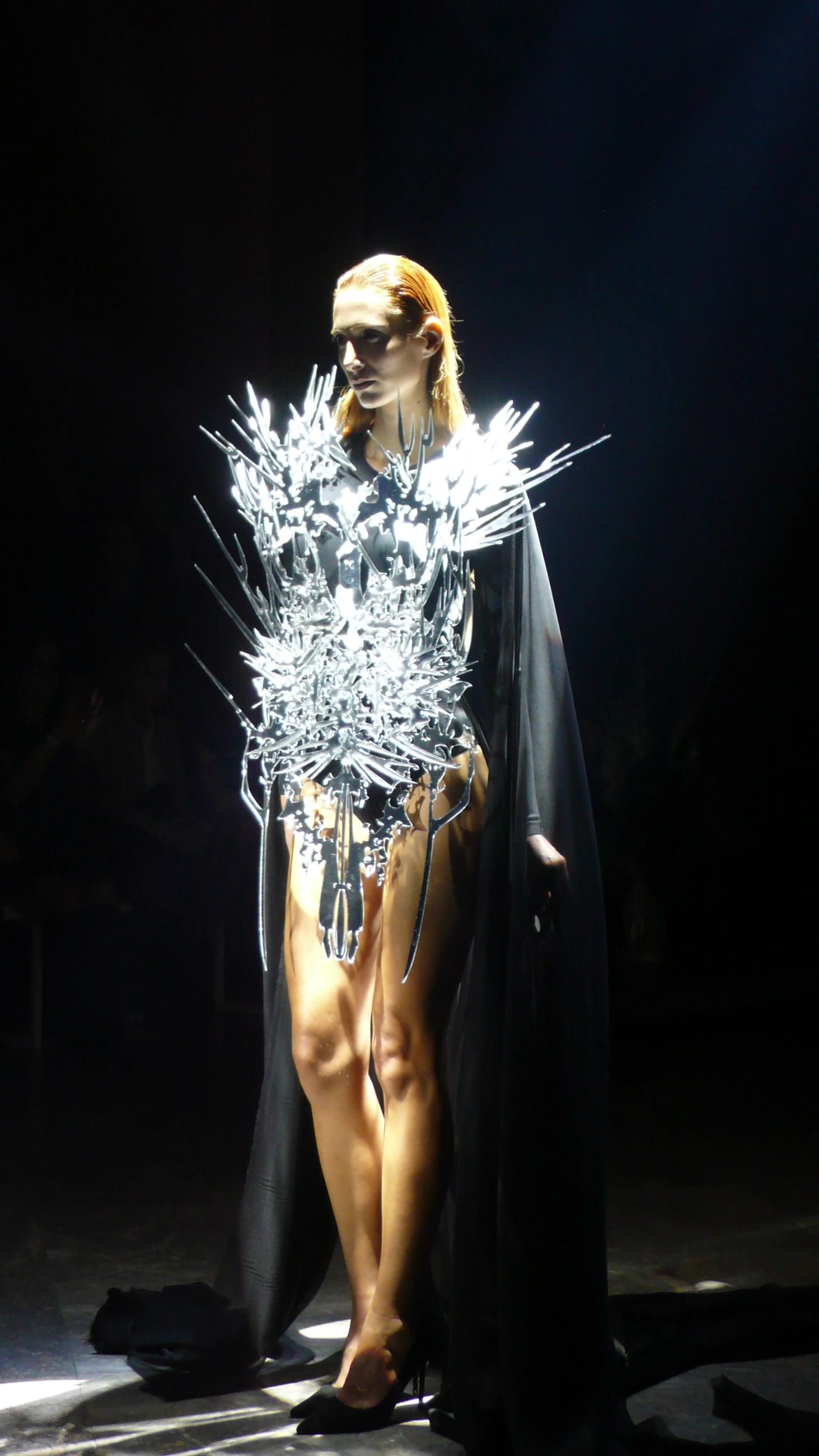
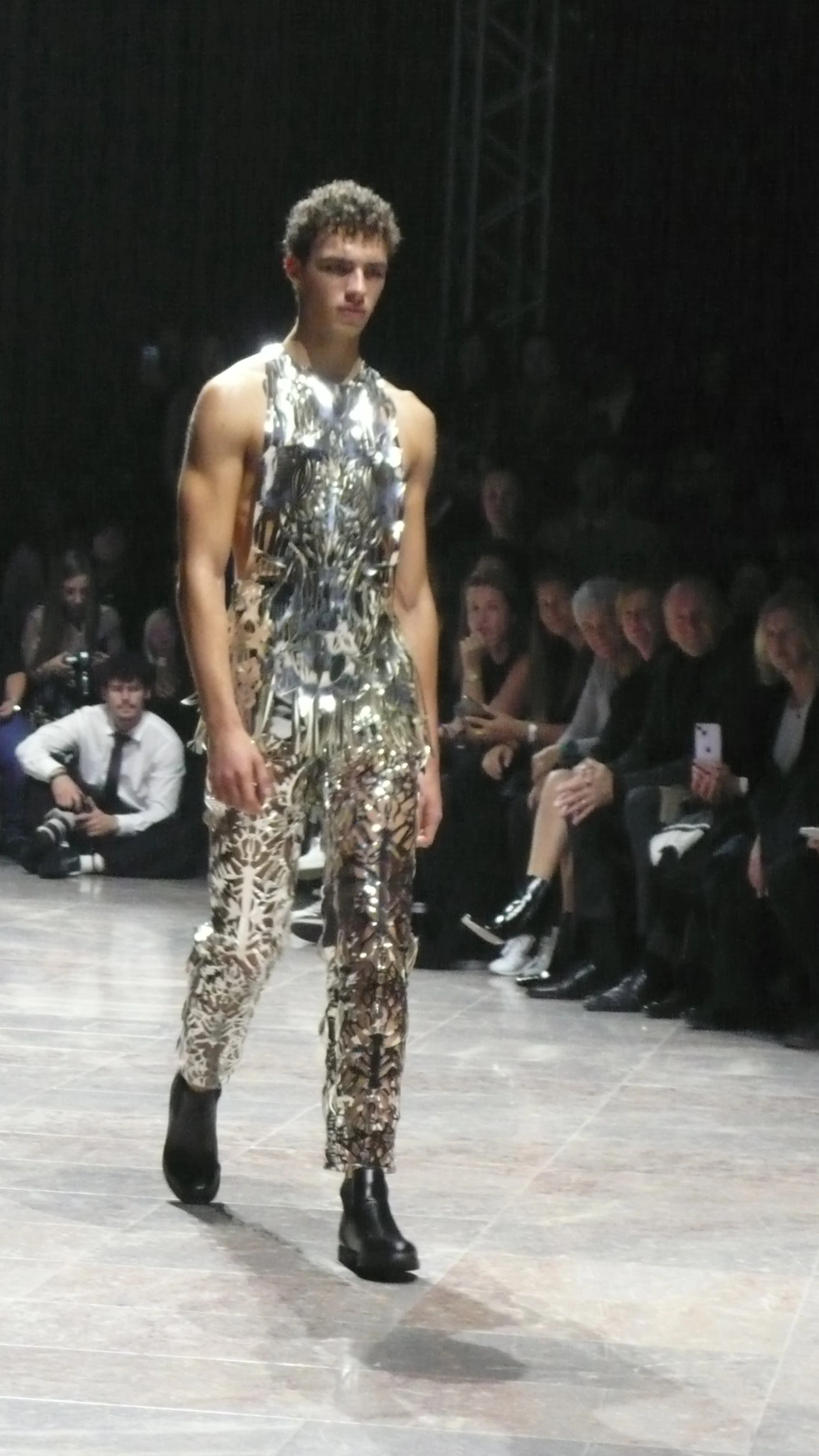
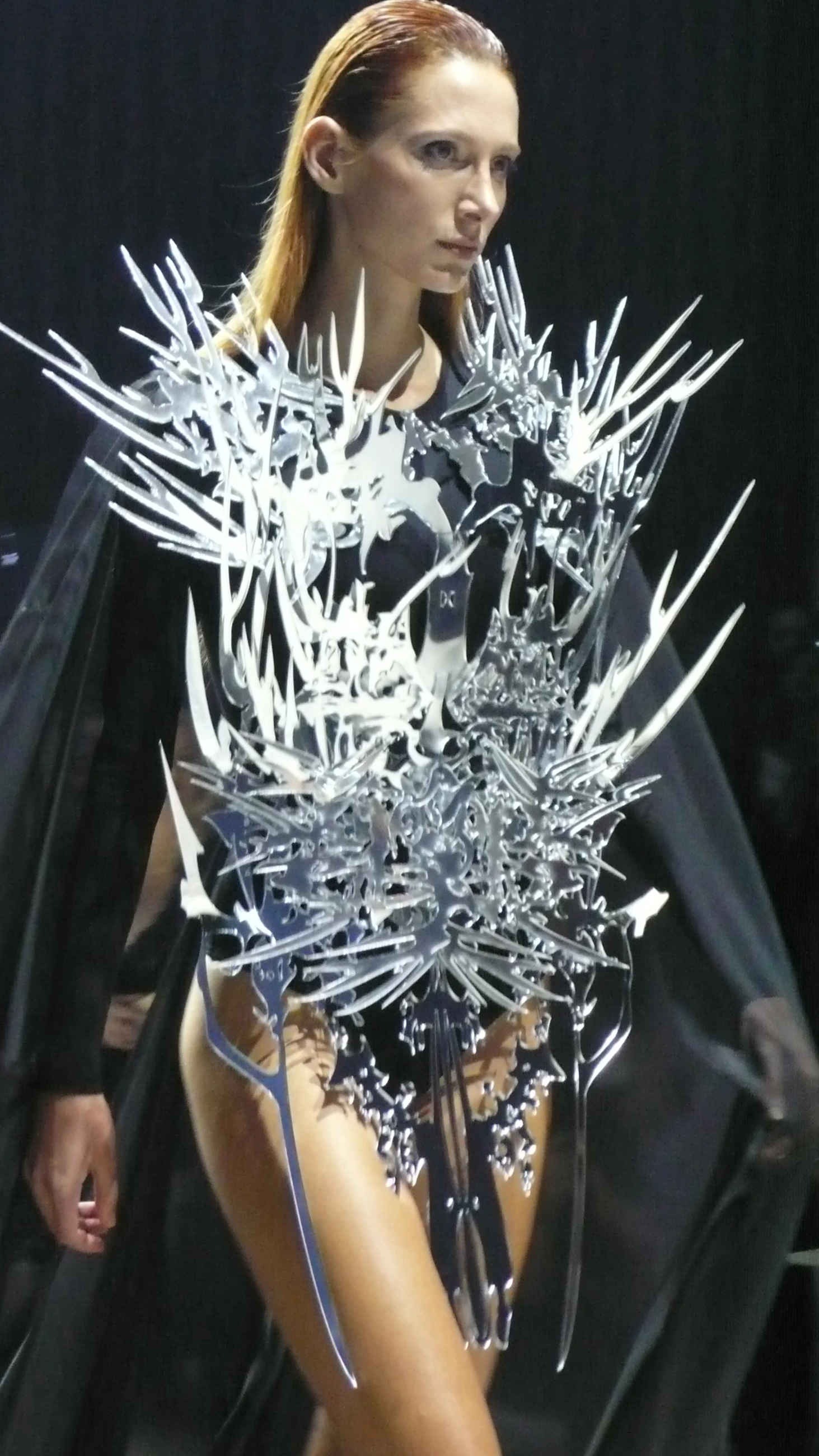
Matic Veler trained at the Royal College of Art and works somewhere between tailoring and sculpture. His signature is laser-cutting, which he uses to carve organic structures and expressive textures out of materials more often found in architecture than in fashion, and Ljubljana audiences already know his work well, having voted him the winner of the week’s Digi WOW award in 2023.
For his Spring/Summer 2027 collection, he collaborated with GEN-I, the Slovenian energy company, on a collection titled The Energy of the Future Through Fashion. He started with the sun and clouds passing across it, translating them through laser cutting into shapes that seemed in constant motion. Delicate gradients of colour moved across the garments like shifting light, and mirror-reflective materials caught the runway lighting and threw it back into the room, so the clothes seemed to generate their own energy as they walked.
Looking back over the ten collections, what struck me most was how many of them looked backwards in order to move forwards. Some reached into national memory, like Morana’s Slavic mythology or Rosc’s trout carriers in Luče. Others went back to personal history, like Zorec’s years in the pool or the Colonia songs of Valenci’s teenage years.
Even the 1950s turned up, through the eyes of a man who spent them as a child in cinemas, studying costumes. Alongside that ran a resourcefulness that never felt like a compromise. Hrastar’s patchwork, Rosc’s deadstock and Zorec’s spliced swimsuits all came out of working with what was already there, and they turned it into collections with real ideas behind them. Ljubljana’s designers have learned to work with limited means, and the best of them have made that a defining part of their style.
The week is not without its difficulties, and most of them have little to do with the designers themselves. Ljubljana Fashion Week still depends on sponsors and on the stubbornness of the people who run it, and the Slovenian Fashion Council that might give its designers steadier support has yet to materialise.
A domestic market of two million people can only absorb so much, so many of the most promising names will need audiences and buyers abroad to keep going. Some are already finding them, through the event’s links with Budapest, Belgrade and Berlin, and through designers like Krebs and Hrastar, who studied abroad and brought what they learned back home.
Slovenian fashion has the talent and the ideas, and over four nights in October it made a persuasive case for itself. Now it needs more people outside its borders to see it, which is why this piece exists.