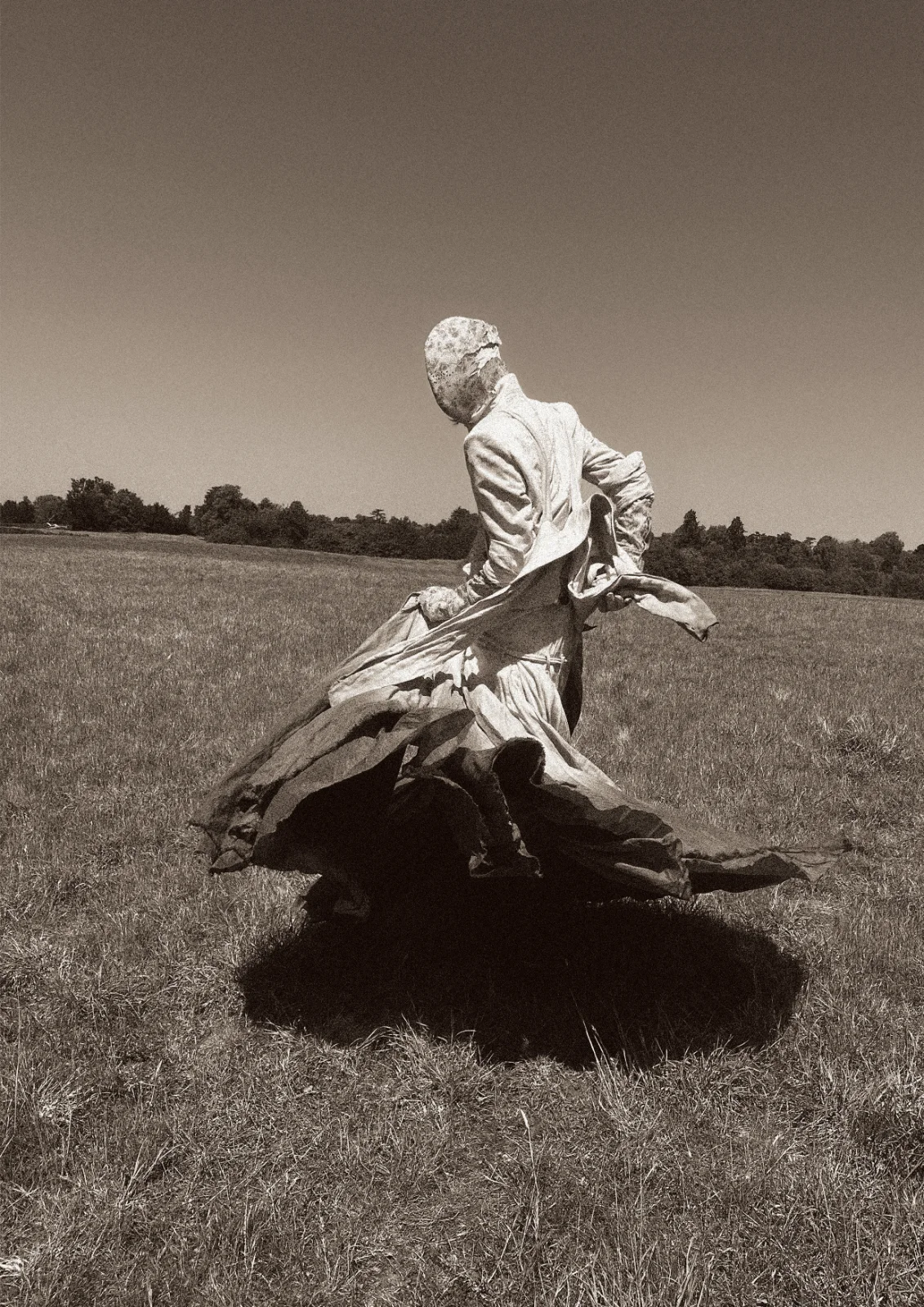
HARVEY BIGG’S FINAL CENTRAL SAINT MARTINS COLLECTION IS A WORLD UNTO ITSELF
Drawing on film props and a fixation on anonymity, Harvey Bigg’s final Central Saint Martins collection reimagines his everyday observations into a capsule of an unexplainable reality.
For the first time in its history, the annual Central Saint Martins BA Fashion show stepped beyond the college’s King’s Cross home, taking place instead at Bold Tendencies in Peckham. Among the forty designers presenting their garments was BA Fashion Design Communication student Harvey Bigg, whose collection undoubtedly caught the eye for its refusal to commit itself to a specific narrative. “I just want to transport everyone watching my six looks to a different world,” he says. “Just for the moment of those six looks and then we snap back to our world.”
Bigg’s collection sat within a cohort of forty students selected from the wider BA Fashion Design programme after an internal show three weeks prior at Central Saint Martins’ Granary Square campus. The final show in Peckham brought press, industry figures and notable alumni (such as Academy Award-winning alumni Sandy Powell) to the repurposed car park where each lineup was staged with an intensity that surpassed the expectations of a graduate showcase. For Bigg, the show marked the culmination of four years at the college.
Raised and still living in Buckinghamshire, Bigg inherited a fascination with fictional universes from his father and grandfather, both of whom worked as film prop makers. His home is, as he describes it, populated by artefacts from other worlds. “Over the years, they picked up oddities that somehow end up living in the house; it’s really funny,” he says. “There’s a chair from a film in our kitchen. It’s not supposed to fit, but it does somehow. We also have a giant cork in our garden from The Borrowers.”
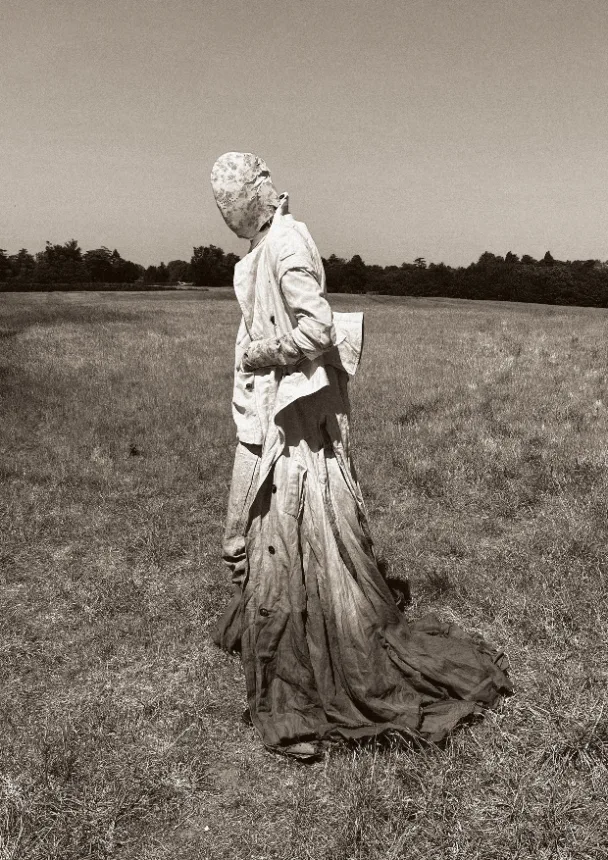
His final collection unfolded like a series of fragments from an alternate reality: militaristic silhouettes, layered textures and subversive styling. Despite the ambiguity of each look, Bigg does not let a concept blur the designs. “You can see definable garments, which I love. I love the fact that nothing in my collection was hazy in shape because I really love clothes and it’s so easy to stray from that when you're doing a show,” he says. “You’re always thinking, ‘Is it going to look big on the runway or is it going to hold its presence?’”
The sense of worlds intruding upon one another became foundational to his design inspiration. “Having all of these amazing objects in my house influenced me to re-contextualise small and odd events in the village I live in,” he says. He likens his process to that of author J.R.R Tolkien, transforming normality into something more. “I guess I used the Tolkien process because for Lord of the Rings he took his experiences in life and re-contextualised them into a fantasy. I wanted to keep it vague, so it's easy for me to design while world-building.”
Walking through his village, he accumulated a portfolio of small moments and sights that would become the source material for his world. “I would document things I see when I go on walks and then create my own alternative sci-fi fantasy from that,” he says. The result is a speculative vision that intentionally resists any clear meaning apart from simply existing. “I find it sometimes gets too much and it can fall into ‘costume’, but I really wanted it to still feel like fashion,” he says. “That was a really important thing for me.” Instead, the collection avoids characterisation, each garment remaining ambiguous.
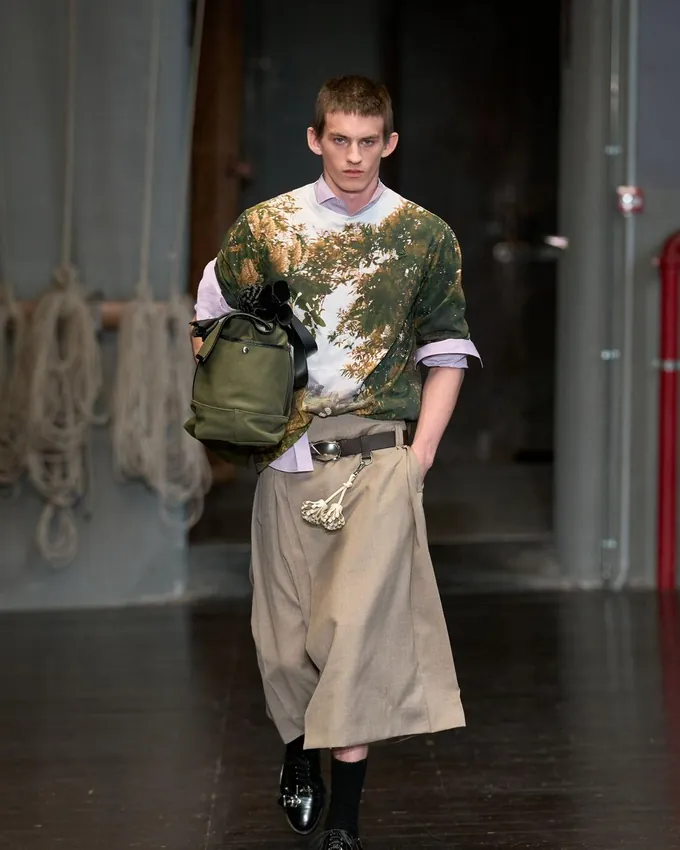
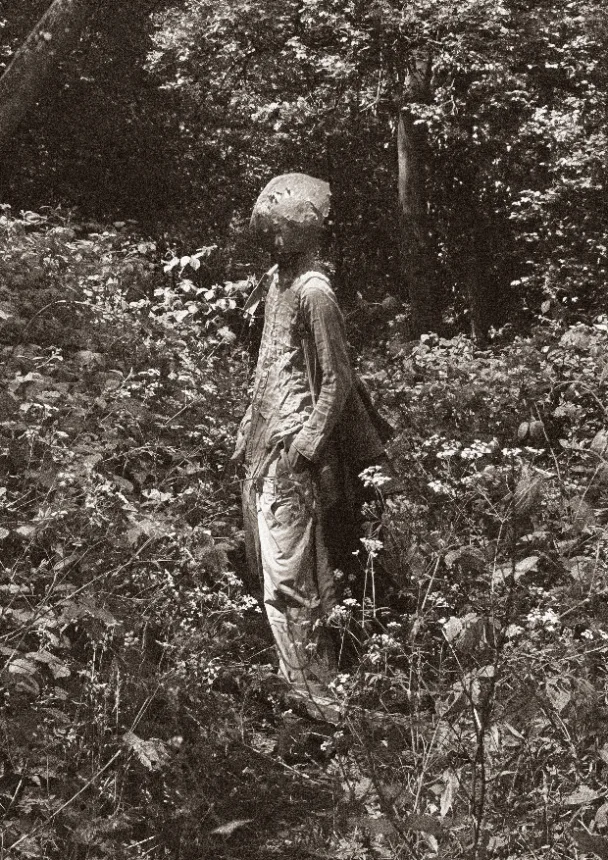
What materialised felt like a squad. Marching out, the looks imagined travellers from a world unlike our own. The collection was imbued with a sense of antiquity, its garments muddied with stories and rich in tactility. He works with predominantly deadstock cotton, linen and antique fabrics sourced from travelling dealers. “I go to their lock-ups where they store so many rolls of cloth,” he says. “It’s really amazing stuff that, if you saw it in shops in London, would cost an arm and a leg.”
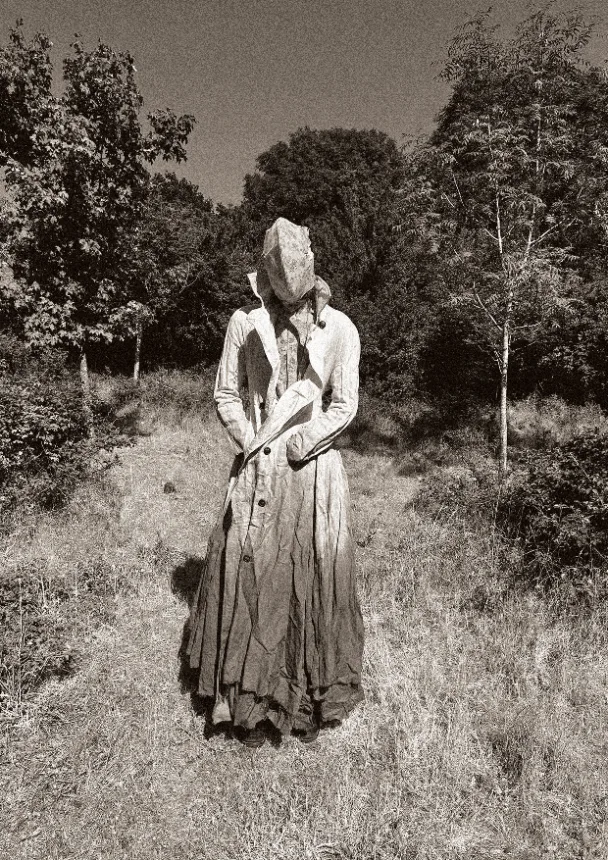
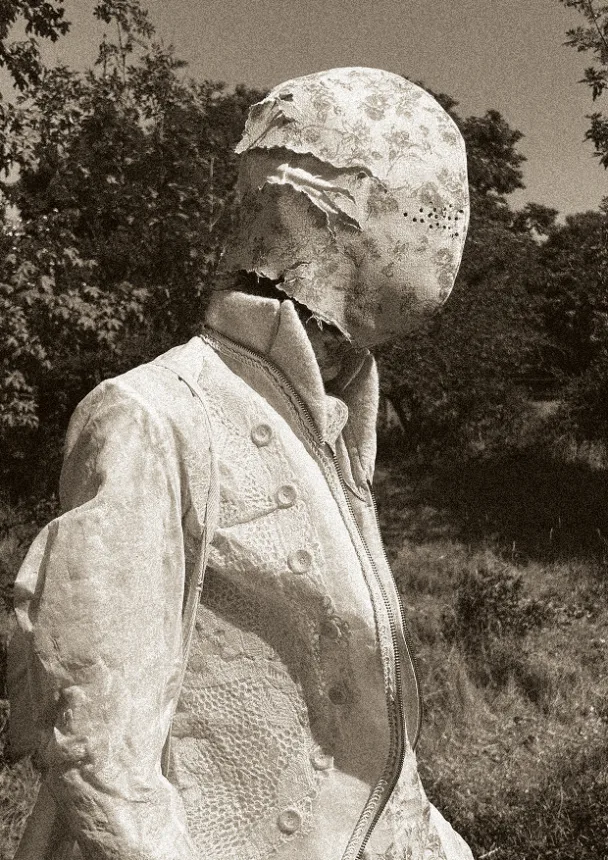
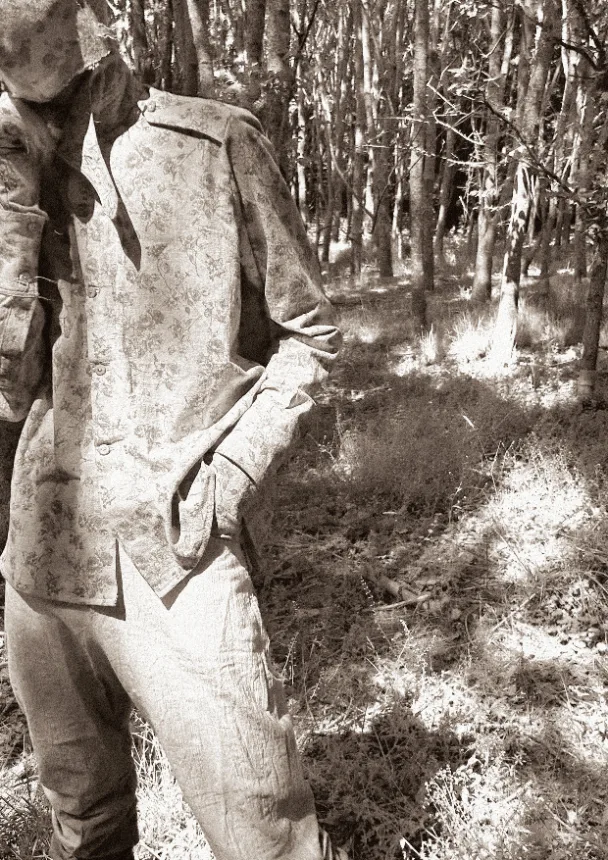
The dusty, muted palette emphasises texture above all. Ombré-gradient dyeing, washing and screen printing are used to produce an impression of age and depth in the fabrics. “I naturally feel for texture more than I do colour. I enjoy having a plain canvas, taking a white or beige fabric and turning it into anything I want.”
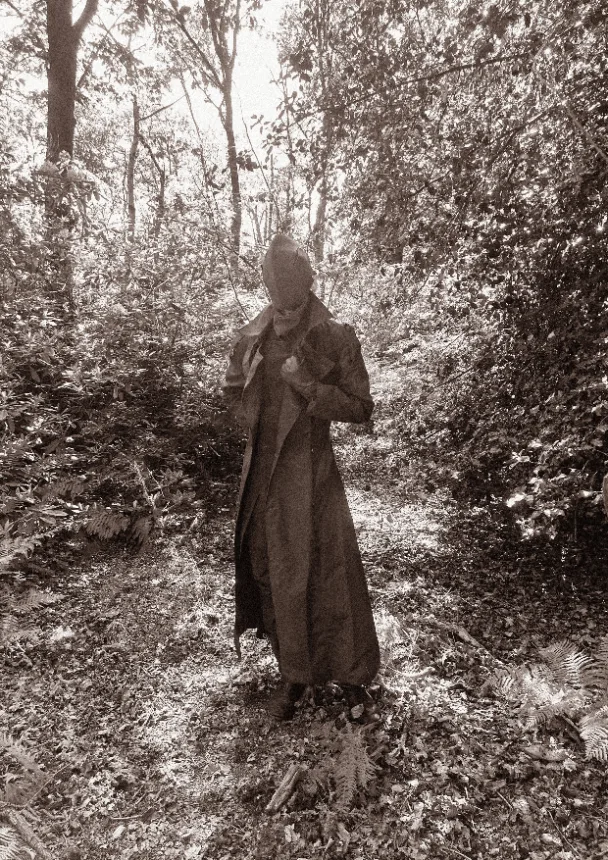
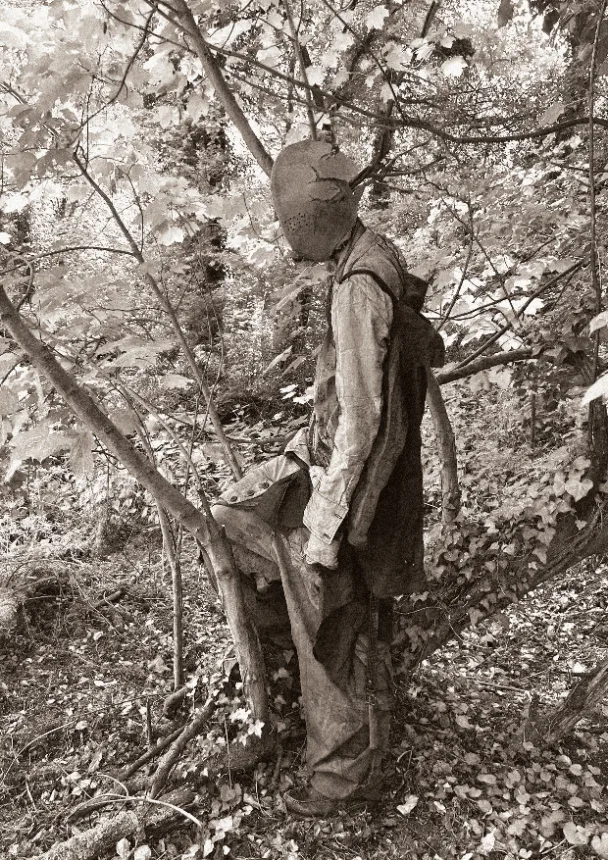
The resulting garments are heavily layered: waxed and washed trench coats over distorted herringbones and floral brocades. “All of my design development comes from styling; then styling gets translated into garments,” Bigg says. Traces of erosion and patina appear in cracked, peeling surfaces as if worn down over years of wear, notably the leather of the hiking boots. A standout look featured a coal and musk-coloured coat layered with a screen-printed flock motif resembling mud splatter, a process he describes as “the most laborious thing I did.”
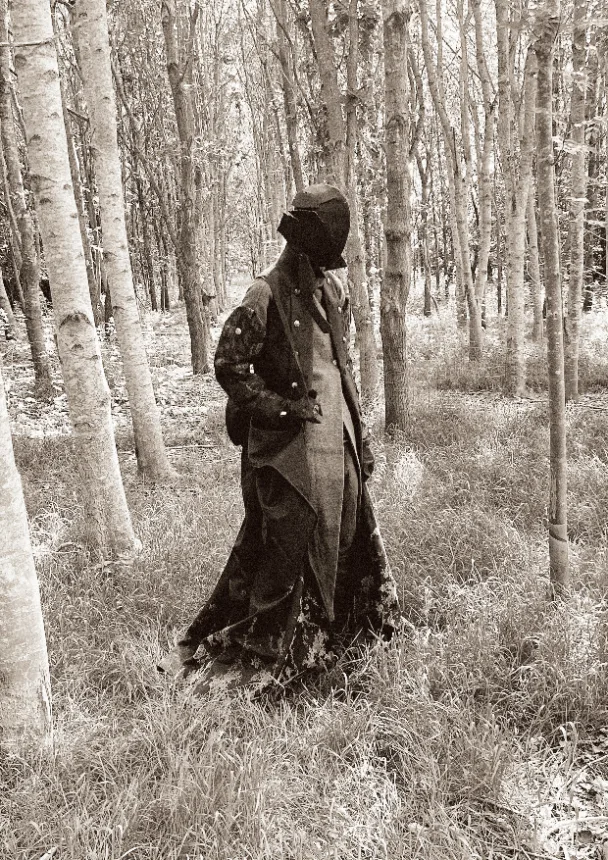
The silhouettes see tailoring and flou work in unison. Trenches drape and drag along the floor, collars remain sharply popped and jacket sleeves peel from the many layers, flowing with movement. “I've always found creating voluminous and exciting menswear really hard, so I started pinning straps and belts to coats and having more elements to hang that created that effect.” Backpacks and bulky satchels extend into trailing structures that function as improvised capes: “I started playing around with backpacks,” Bigg says. “Guys always wear them and when clothes start falling out, it becomes like a male version of a dress train.”
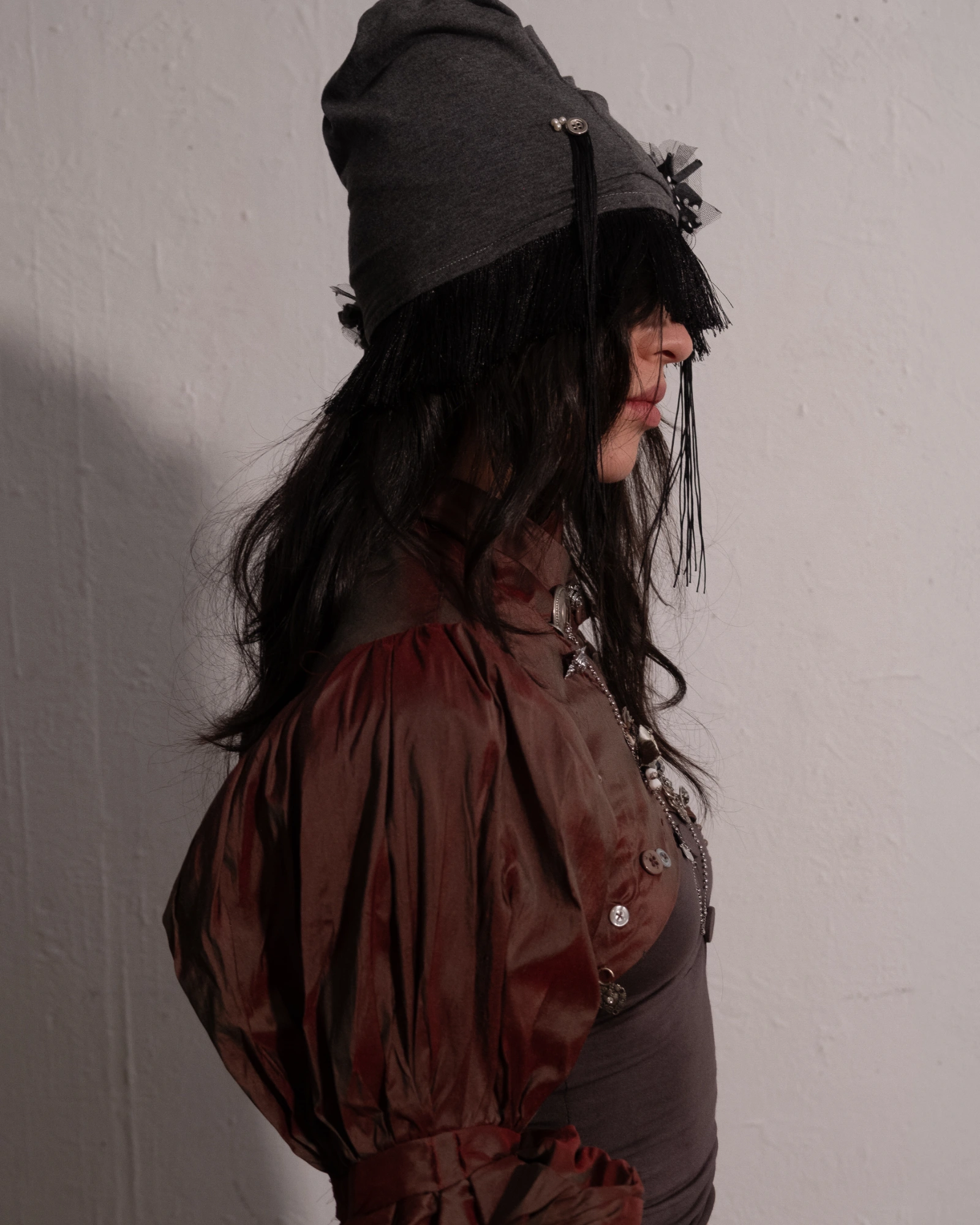
“I'd always play games where you can customise your character, but there's definitely bigger meanings in there for why I didn't show the faces,” he says regarding the obscure masks worn with each look. This concept of anonymity has run through his work since his second year: “The clothes should do enough; they’re rooted within our history, cultures and archetypes, which is human enough. I guess that's even quite bizarre in itself, completely removing the physical human from the fashion.”
Each showcasing designer was given the choice of audio to accompany their collections, and Bigg chose his favourite song: Black Country, New Road’s “Snow Globes.” The din of drums and strings swelled cinematically, a tone that felt as resonant and expansive as the garments. “It felt very orchestral, but modern,” he says. “I wanted something that reinforced the clothes, and I was playing around with doing happier songs, but they just didn't match. I always knew it would be that song.”
Within the BA Fashion Design Communication programme — led by Stephanie Cooper — Bigg describes a culture defined by autonomy. “I came straight here without a foundation; it’s like being thrown in the deep end. When it comes to executing ideas, that's on you. You’re marketing yourself and your world, not just the clothes.” He credits his ability to eventually do so to his year in the industry working at YAKU, the label of MA Fashion Design alumni Yaku Stapleton. “My intern year really solidified the disciplines, abilities and skills to execute ideas,” he says. “They really took me under their wing.”
After the final show at Bold Tendencies, Bigg received a whirlwind of validation from publications, platforms and peers alike. “This show probably ends up being bigger on socials than some brand shows,” he says. “We are just amateurs, but we take over fashion social feeds for like three days. My account has tripled since that show, and I've had some really awesome responses.”
The most significant moment, he describes, came with the quiet after the storm. “I enjoyed the relief after I packed everything up because the show is super overstimulating. Weirdly, you don't know what you've done,” he says. “When I came outside, my old bosses were there; they told me how much they enjoyed the collection. Then it started to dawn on me that I'd created something quite nice.”
Rather than attaching a definitive message to his work, Bigg remains focused on the act of making itself. Even after wrapping up four years of study and two runway shows, for him, finishing one project means starting another: “If this course and making this collection have proven anything to me, it’s that making clothes is like an addiction rather than a want to make.”