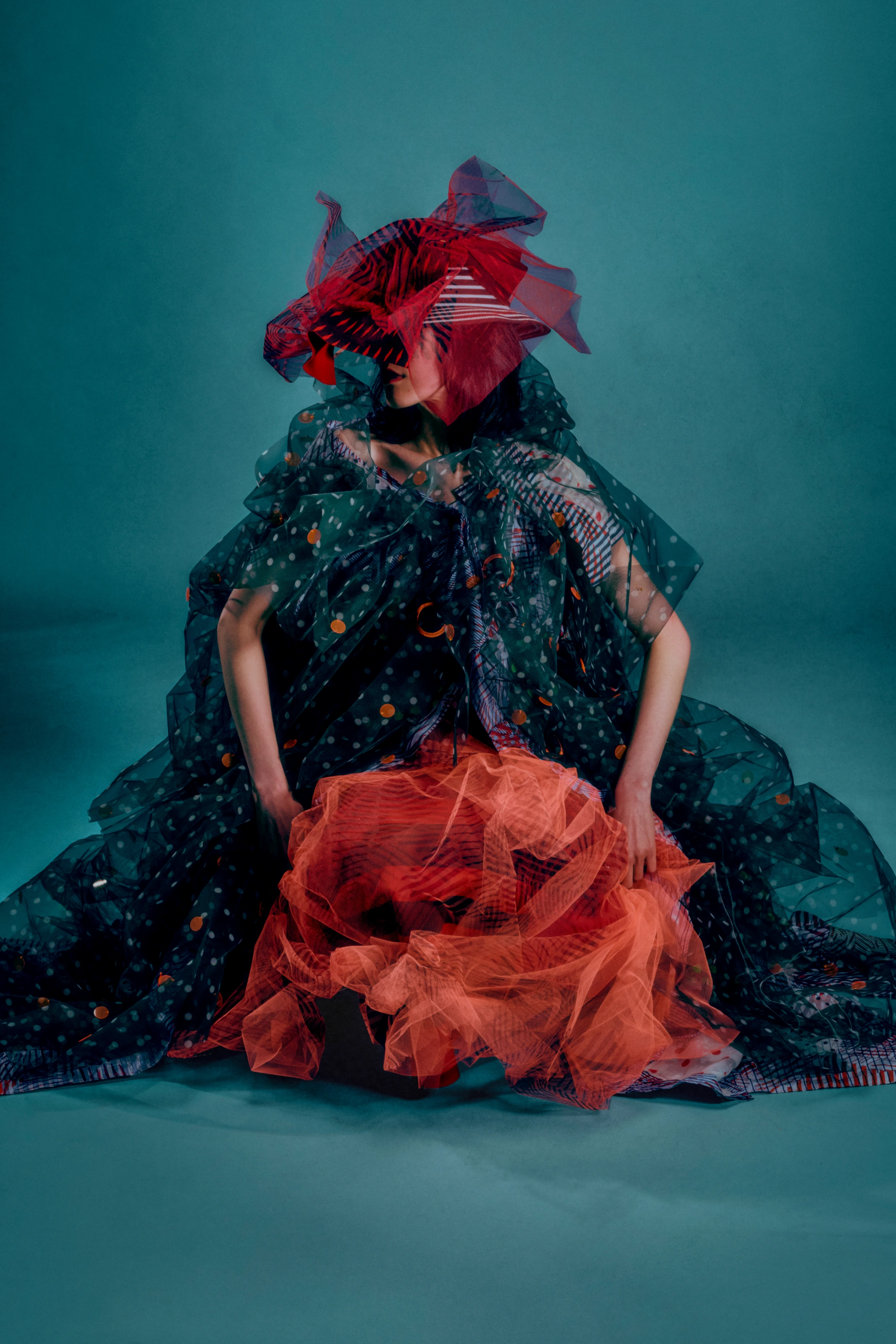
Inside Dissociated, Maria Goundry's Graduate Collection
Maria Goundry's Central Saint Martins graduate collection turns dissociation into something you can look at, using moiré, warped pinstripes and layered deadstock to make familiar clothing come apart.
Maria Goundry graduated this year from Central Saint Martins' BA Fashion Design: Print with Dissociated, a collection built around a psychological state she had experienced herself and found almost impossible to explain to anyone else. Dissociation, the sense of a layer sitting between you and reality, is common enough that many people encounter it in some form, and it tends to be endured privately. Goundry's response was to make it something you could look at. She started from the most ordinary clothing she could find, the pinstriped shirts, tailoring and pencil skirts she saw on her daily commutes across London, and let those garments come apart as the collection progressed.
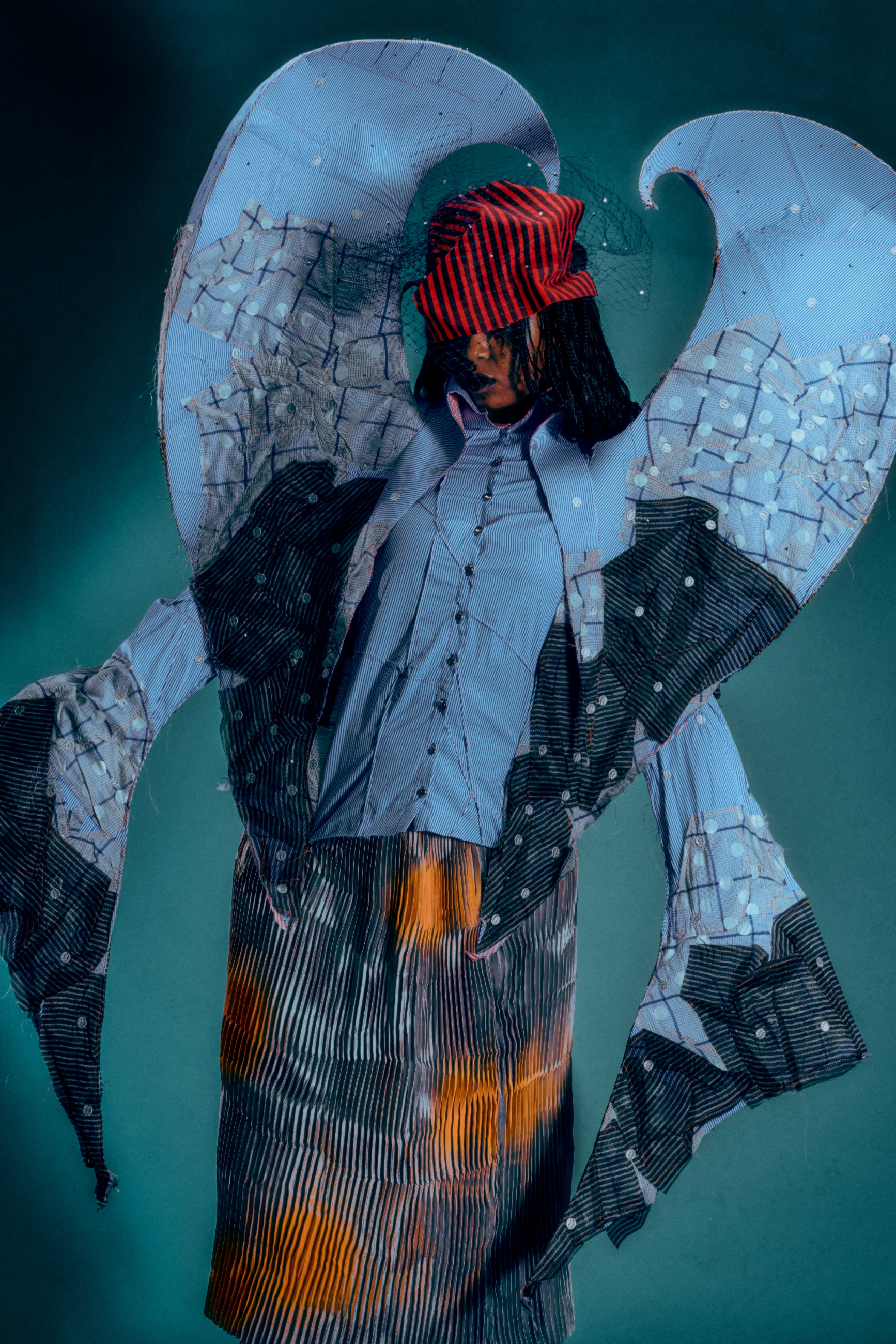
The work is entirely deadstock and upcycled, hand-drawn and screen-printed by Goundry in London, and cut experimentally in response to whatever material she could source. Stripes travel in directions they shouldn't. Moiré patterns shift while you look at them. The coat in Look 6 began as 20 by 20cm squares of blue striped fabric, each screen-printed individually, then buried under tulle, sheer deadstock, embroidery and sequins until only traces of the original remained. It is loud work, made under the kind of material constraints usually associated with something much quieter. We spoke to Goundry about print as a starting point, the difference between a disorienting pattern and a decorative one, and what she wants her own label to stand for.
- You’ve just graduated from CSM’s BA Fashion Design: Print. What drew you to print specifically, and how does starting from print rather than silhouette change the way you build a garment?
I was initially drawn to study print because I noticed how I gravitated and had a love towards printed fabrics and clothing. I also love drawing and creating visuals; I was just as interested in the textiles of a garment as I was in the garment itself. What really fascinated me was realising that print doesn’t have to simply sit on top of a garment as decoration; it can actually change how you perceive the shape and the construction of the garment itself.
My process is very much a back and forth between print and silhouette. Sometimes I start with print and sometimes with the garment. I might develop a textile experiment that suggests a particular construction, or begin manipulating a silhouette and realise that a print could exaggerate it or create an interesting contrast with it. Studying Fashion Print was a great decision for me because it taught me to think about the surface and construction of a garment as interconnected, while also giving me the freedom to focus more heavily on either textiles or silhouette depending on what I’m trying to achieve.
- Dissociated takes something very internal and hard to describe and makes it wearable. When did you know dissociation was going to be the whole collection, and what was the first design decision that came out of that?
I knew before I started the collection that I wanted dissociation to be the subject. It was something I had experienced myself but found incredibly difficult to explain to other people, and that difficulty was actually what made me interested in trying to communicate it visually.
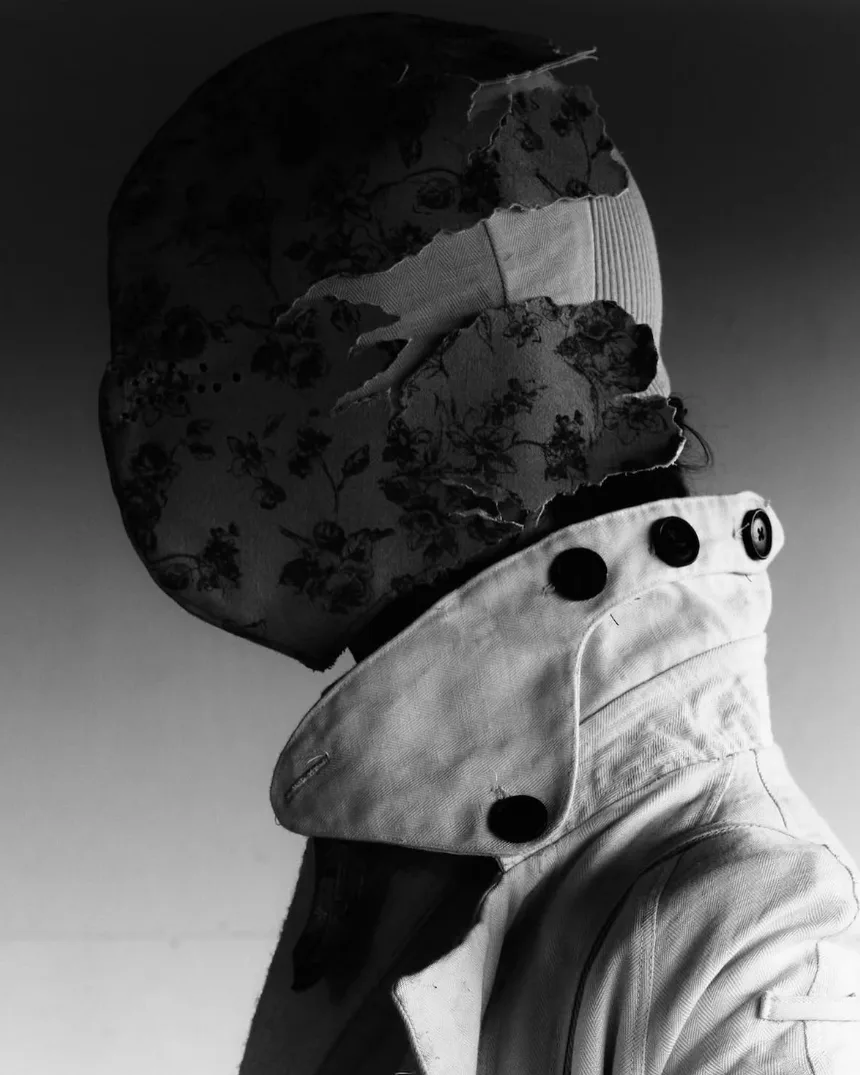
The first important design decision was to start with familiarity rather than immediately making everything surreal. I looked at very recognisable, everyday clothing, particularly office wear, because dissociation can make completely normal surroundings suddenly feel strange or unreal. I began paying attention to the familiar garments I saw around London, particularly during my daily commutes — pinstriped shirts, tailoring and pencil skirts — and used these as a starting point, gradually destabilising and distorting them throughout the collection.
- You describe the sensation of familiar surroundings suddenly turning unfamiliar. What does a garment actually have to do to make someone feel that instability, and how did you test whether it was working?
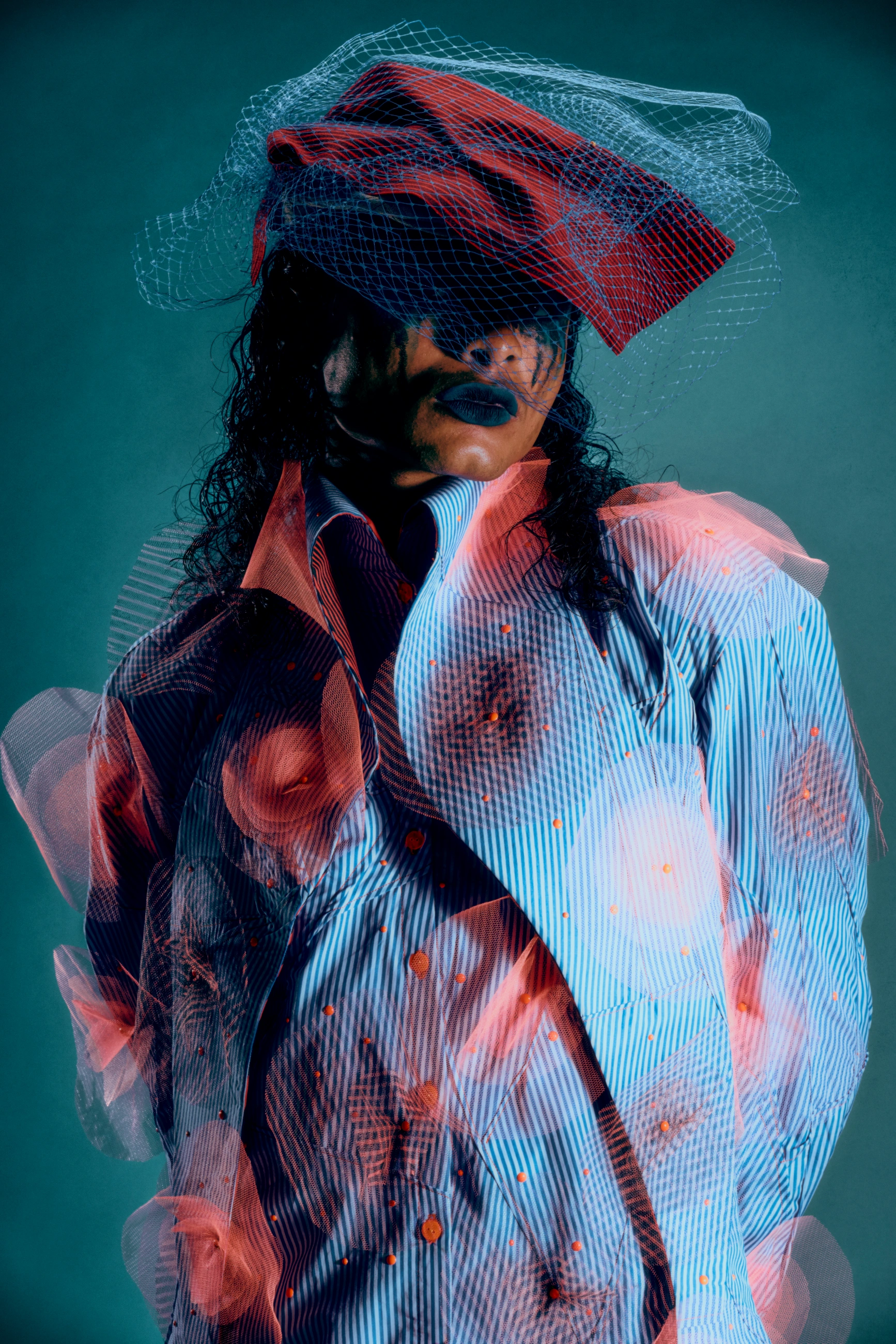
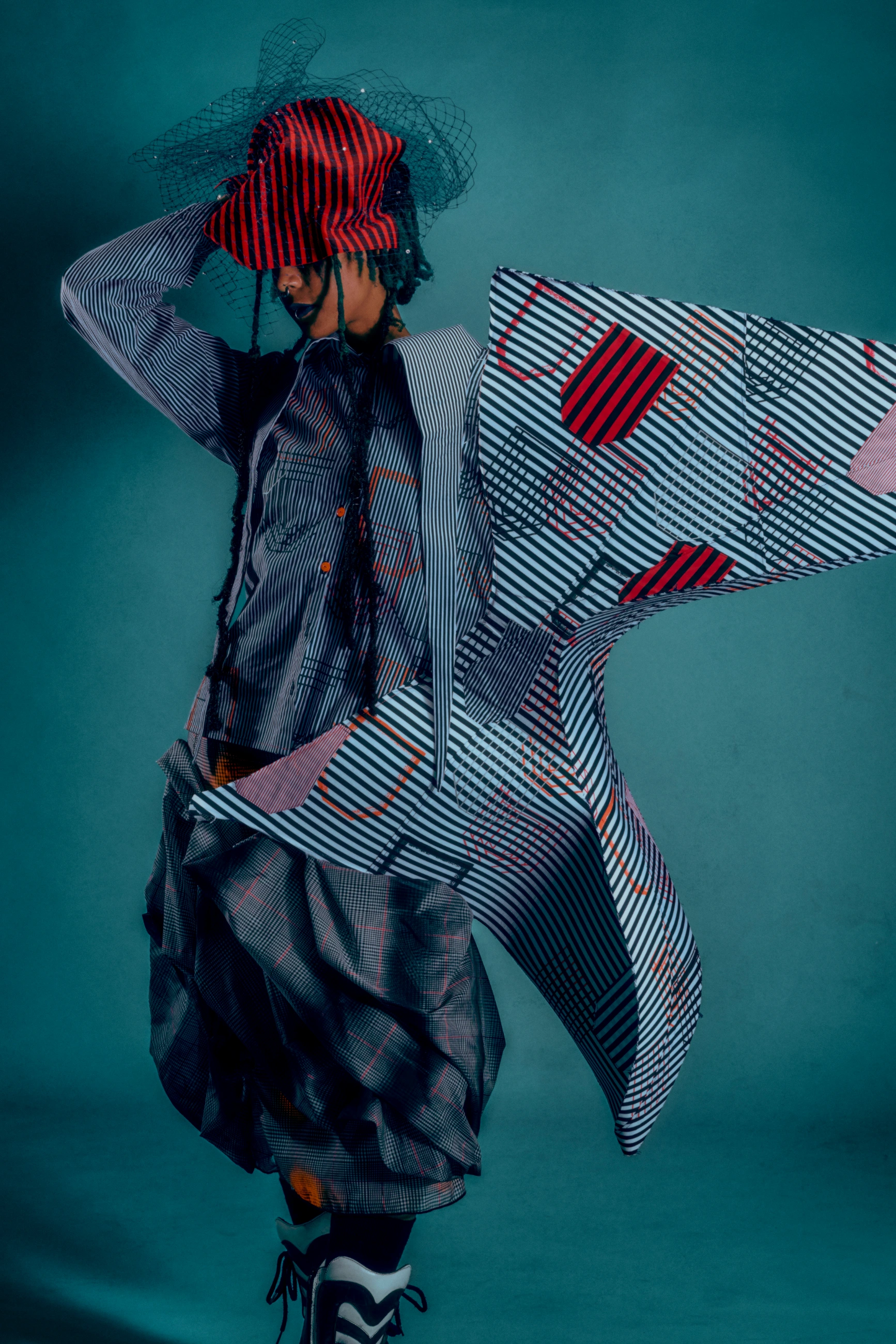
I kept recognisable elements of clothing but manipulated them through scale, proportion, print and optical illusion. You might recognise a shirt or a pinstripe, but then the stripe moves in a direction it shouldn’t, the silhouette behaves differently from what you expect, and if you look more closely, further layers begin to reveal themselves.
I started by figuring out how I could visually express the internal experience of dissociation. I researched Surrealism and Op Art quite extensively, as I found that works from both movements could evoke sensations similar to my own experiences of dissociation. Surrealism helped me explore the feeling of familiar things becoming strange or uncanny, while Op Art gave me a way to experiment with visual distortion and instability.
Testing was then a very visual and physical process. I experimented directly with different fabrics and prints, as well as drawing, layering and draping, constantly looking at how these elements interacted and changed my perception of the garment. I knew an experiment was working when the effect wasn’t immediately obvious or easy to understand, but instead made you feel somehow disorientated, confused or even slightly uncomfortable.
- The collection gives visibility to something you say is often endured in silence. How much of it comes from your own experience, and how did you decide how much of yourself to put into something this public?
It comes very directly from my own experience. A lot of the sensations I was trying to recreate — feeling disconnected from your surroundings, familiar places suddenly looking unfamiliar, or feeling as though there is a layer between yourself and reality — came from things I had experienced personally.
Dissociation is something that has caused me quite a lot of suffering in the past, and I have always found it very difficult to explain in words. When I first experienced it, I didn’t know what dissociation was. I felt scared and confused because I didn’t understand what was happening to me. I now know that dissociation, in varying degrees of severity, is experienced by many people, and I wanted the collection to bring more attention and care to a psychological state that can be very difficult to communicate. I think we need to be able to speak more openly about mental health and experiences like dissociation, particularly because not understanding what is happening to you can make an already frightening experience feel even more isolating. I hope that someone who has experienced something similar might recognise themselves in the work and feel seen.
Through the collection, I found that I could communicate the feeling without having to disclose every personal experience behind it, so there was still a boundary between myself and the work. The emotional starting point is very personal, but what I chose to make public was my visual interpretation of that experience.
- Everything is deadstock and upcycled, screen-printed and experimentally cut. Talk me through one look from raw material to finished piece — what did you start with, and how far did it travel?
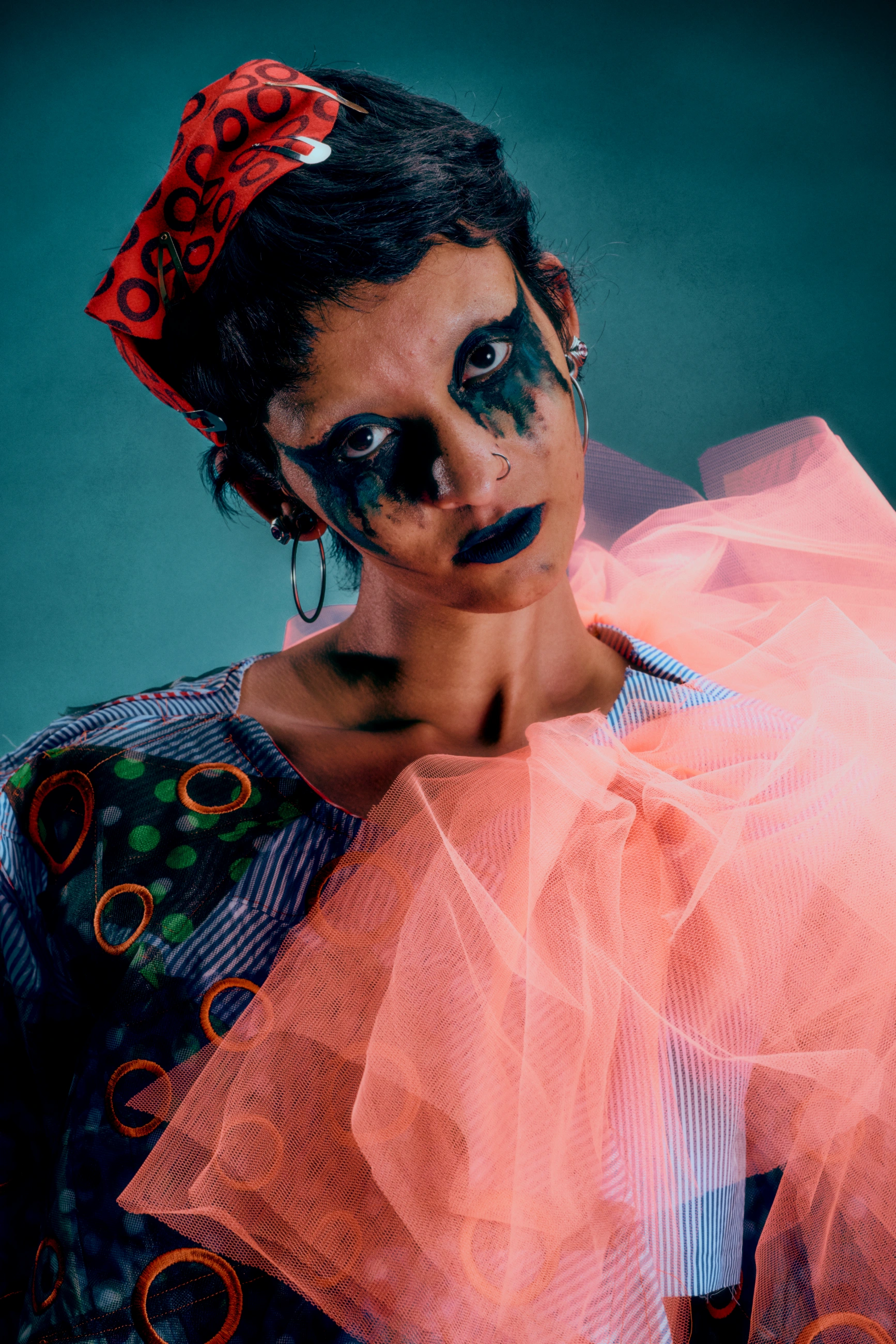
At the beginning of the collection, I gathered fabrics and materials that aligned with the research and colour palettes emerging from my sketchbooks. I experimented with what I found and allowed the materials themselves to become part of the design process. Of course, when working with deadstock and upcycled materials, you only have a certain amount available, so you have to be endlessly creative. If there isn’t enough fabric to make the garment you originally designed, you have to find a solution that still feels in keeping with the design and the world you are trying to build. That limitation became an essential part of my process.
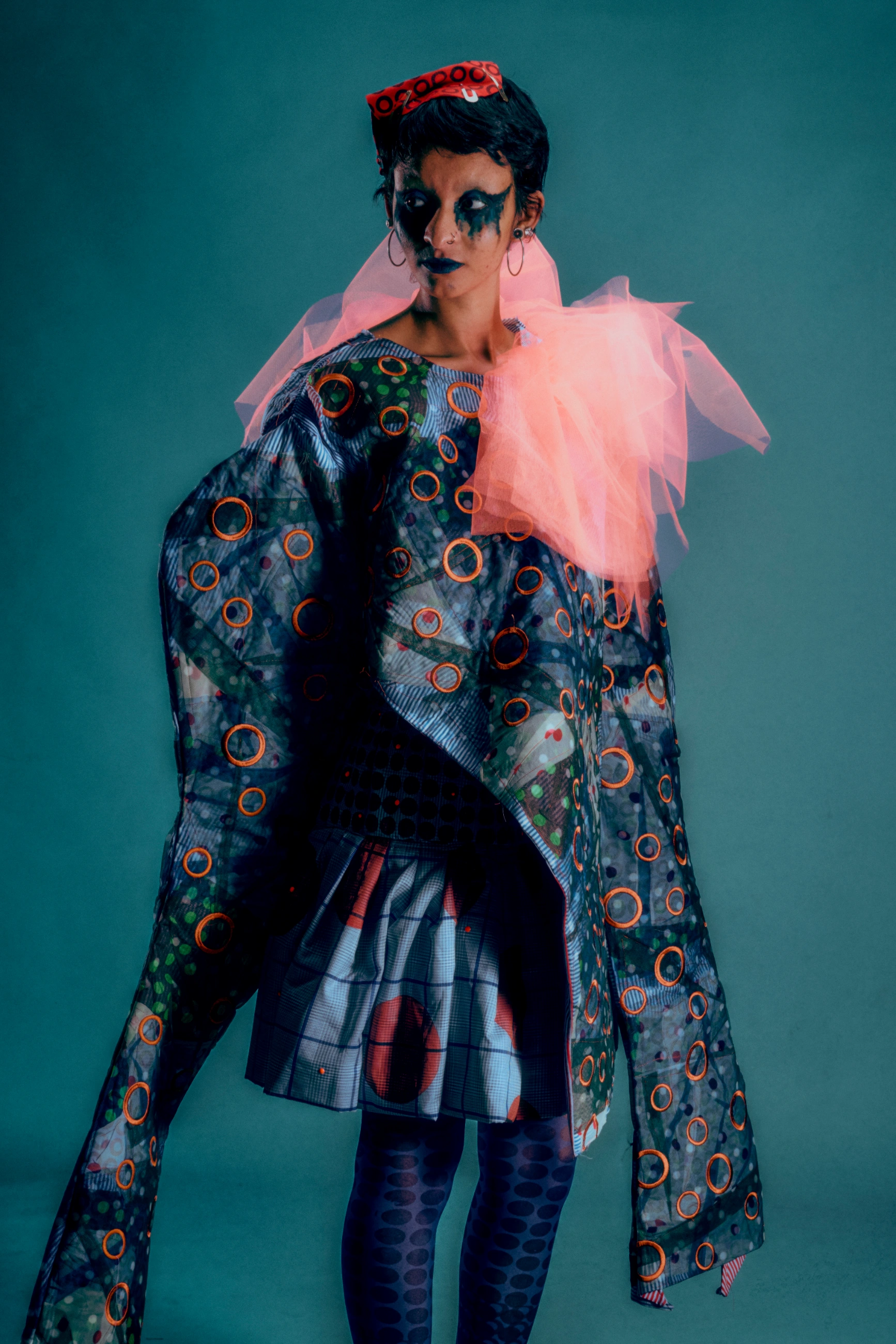
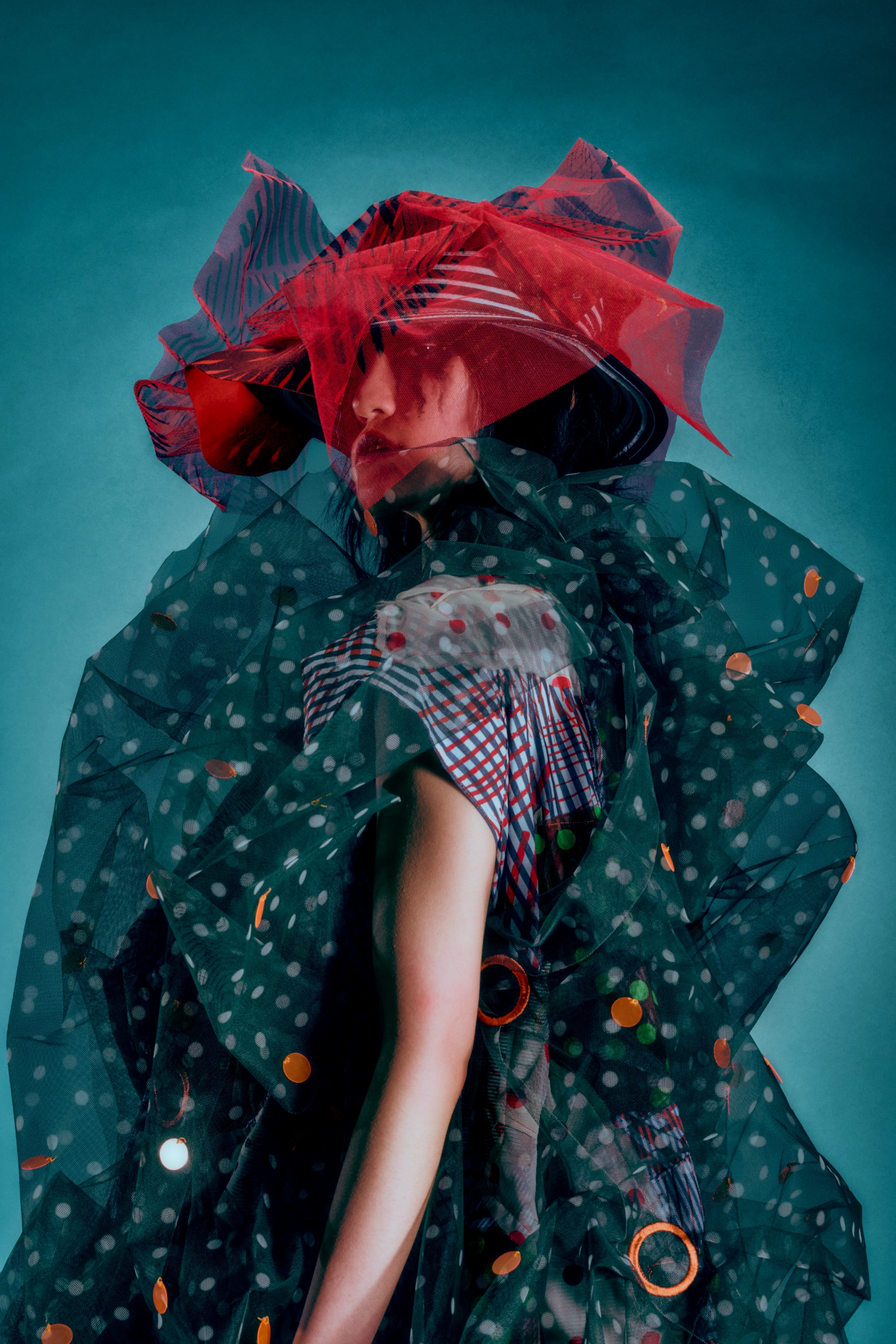
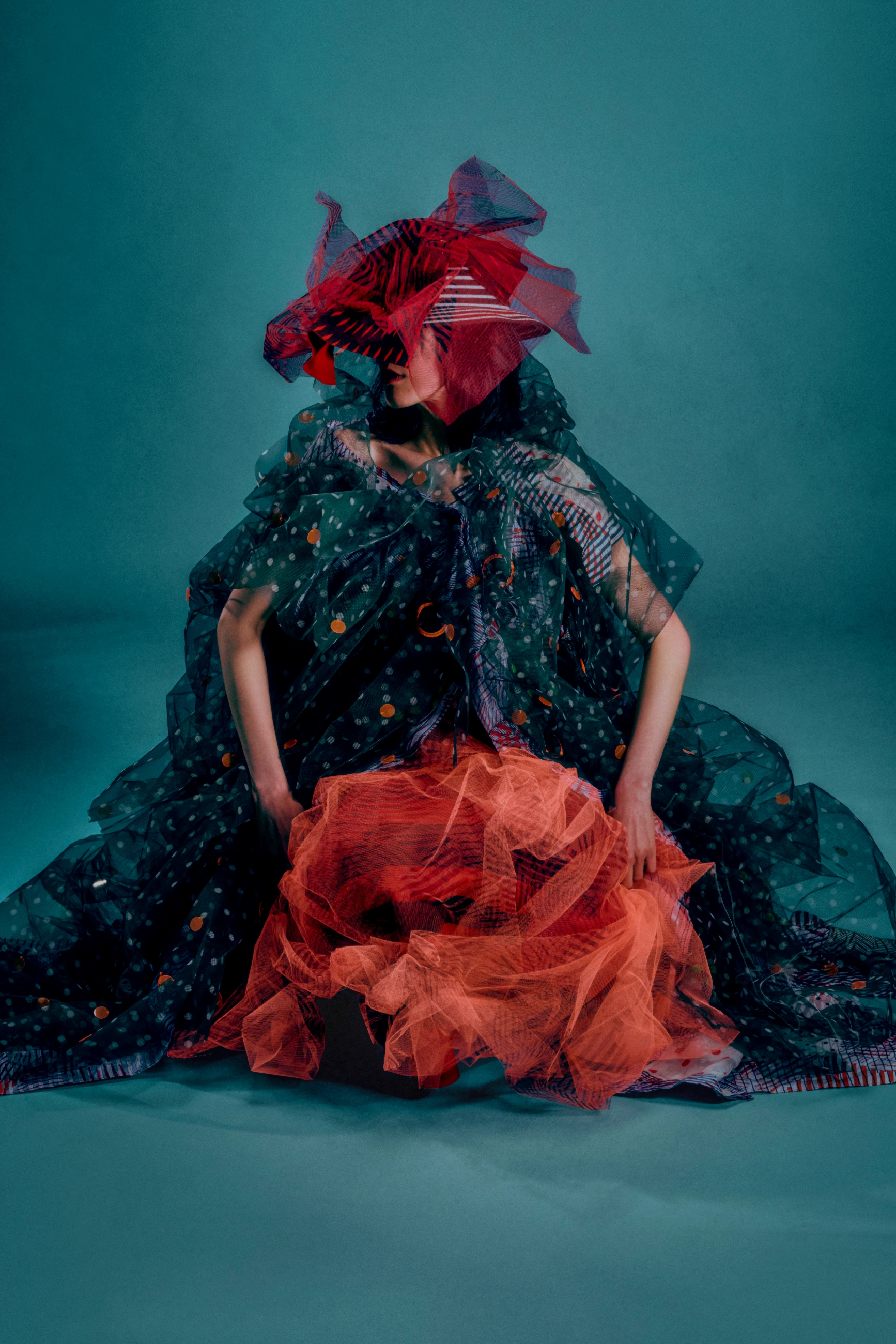
The coat from Look 6 is probably the best example of how far a material can travel, because there are so many layers within that one piece. I started with small squares, around 20 × 20 cm, of different blue striped fabrics and individually screen-printed each one with my own hand-drawn design. I then pieced and sewed them together so that the stripes travelled in different directions, disrupting the original patterns.
Over that, I added tulle that I had screen-printed with another hand-drawn design, followed by various sheer deadstock fabrics that picked up colours and elements from the collection. I then scrunched and manipulated tulle directly onto the surface, carefully pinning it into position before embroidering circles through the layers. Once embroidered, I removed the pins so that the tulle was held and shaped purely by the embroidery. Finally, I applied sheer sequins in the same colour as the embroidery across the tulle.
By the end, those small pieces of striped fabric had become almost completely transformed and partially obscured beneath layers of print, transparency, embroidery and texture, but you can still find traces of where the garment began. I think that transformation really reflects what I love about working with existing materials: rather than seeing their limitations as a problem, I can respond to what is already there and give it another life.
- The pinstriped shirts and tailored pieces unravel and distort as the collection progresses. Was that breakdown planned from the outset, or did it emerge while you were making?
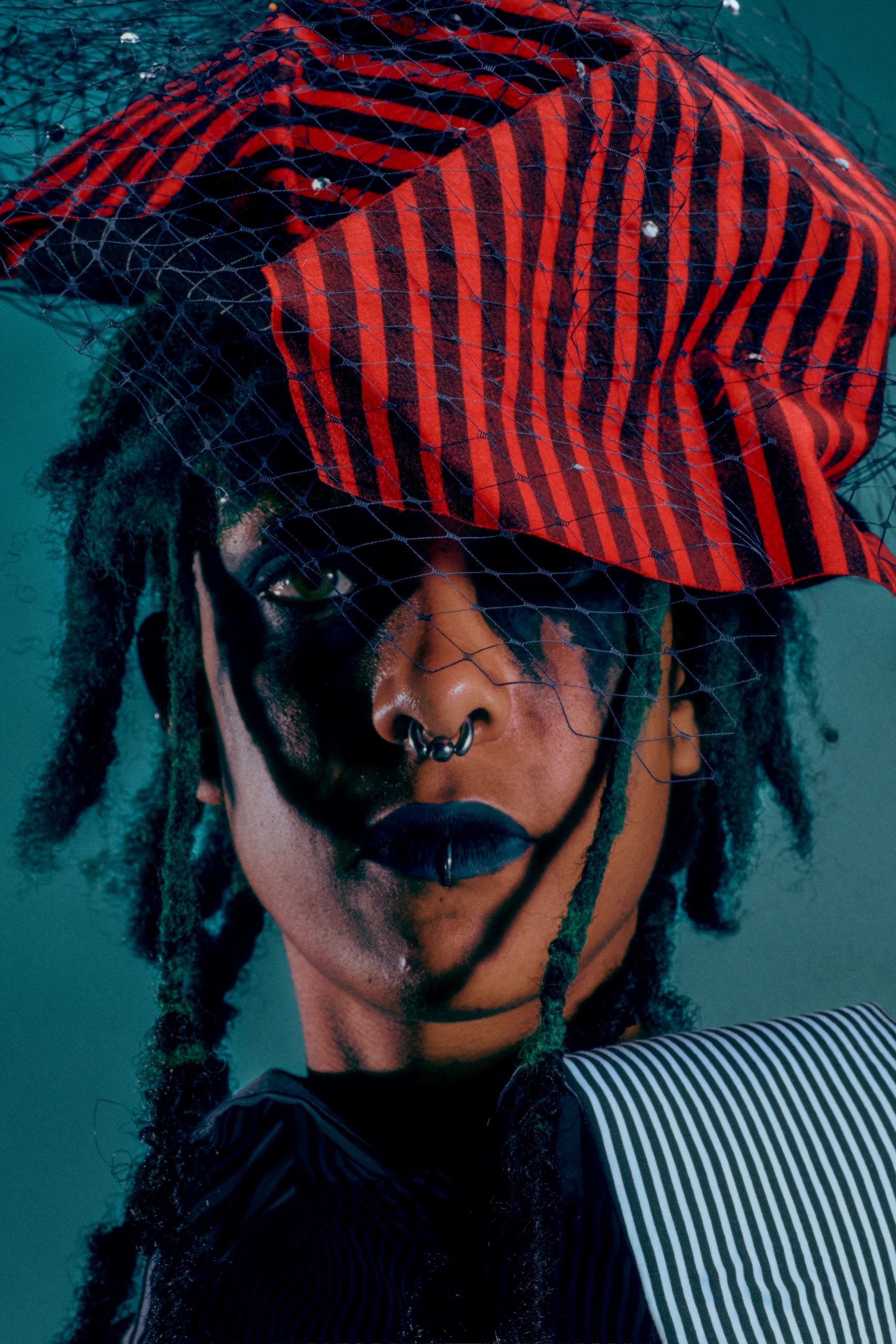
Early on, I wanted the collection to follow the progression of a dissociative experience, beginning with something relatively normal and recognisable and becoming increasingly distorted and disconnected.
I didn’t plan exactly how that breakdown would happen. That came through making. Each experiment gave me something I could push further: stripes became more distorted, silhouettes became less conventional and recognisable, and garments started to fragment. So the progression was intentional, but the specific forms it took emerged through experimentation.
- Moiré, layered stripes and warped patterns are doing a lot of the heavy lifting. How did you develop those prints, and how much trial and error went into making a pattern read as genuinely disorienting rather than just decorative?
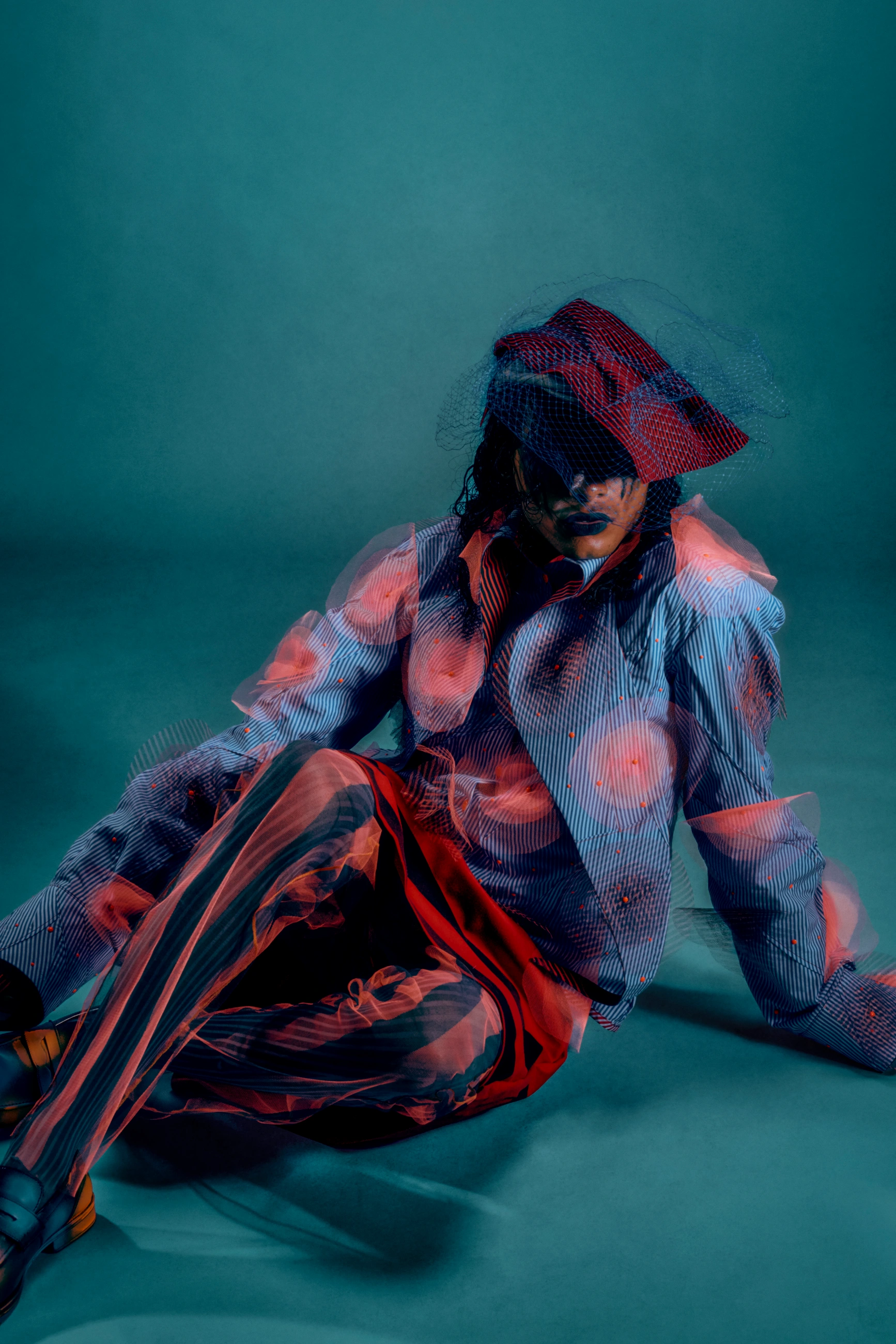
There was a huge amount of trial and error. I became interested in moiré because it creates an image that almost seems to move, even though nothing is actually moving. I developed different striped and grid-based patterns, changed their scale and direction and layered them physically and digitally to see how they interfered with each other.
The distinction between disorienting and decorative was really important to me. If I made something that simply looked like an interesting print, I didn’t necessarily consider it successful. I wanted the prints to interfere with your perception and create a slight sense of discomfort or uncertainty, while also drawing you in and making you want to understand what was happening and look more closely. A lot of the process was therefore about adjusting scale, transparency, placement and layering until the effect became difficult for the eye to fully resolve.
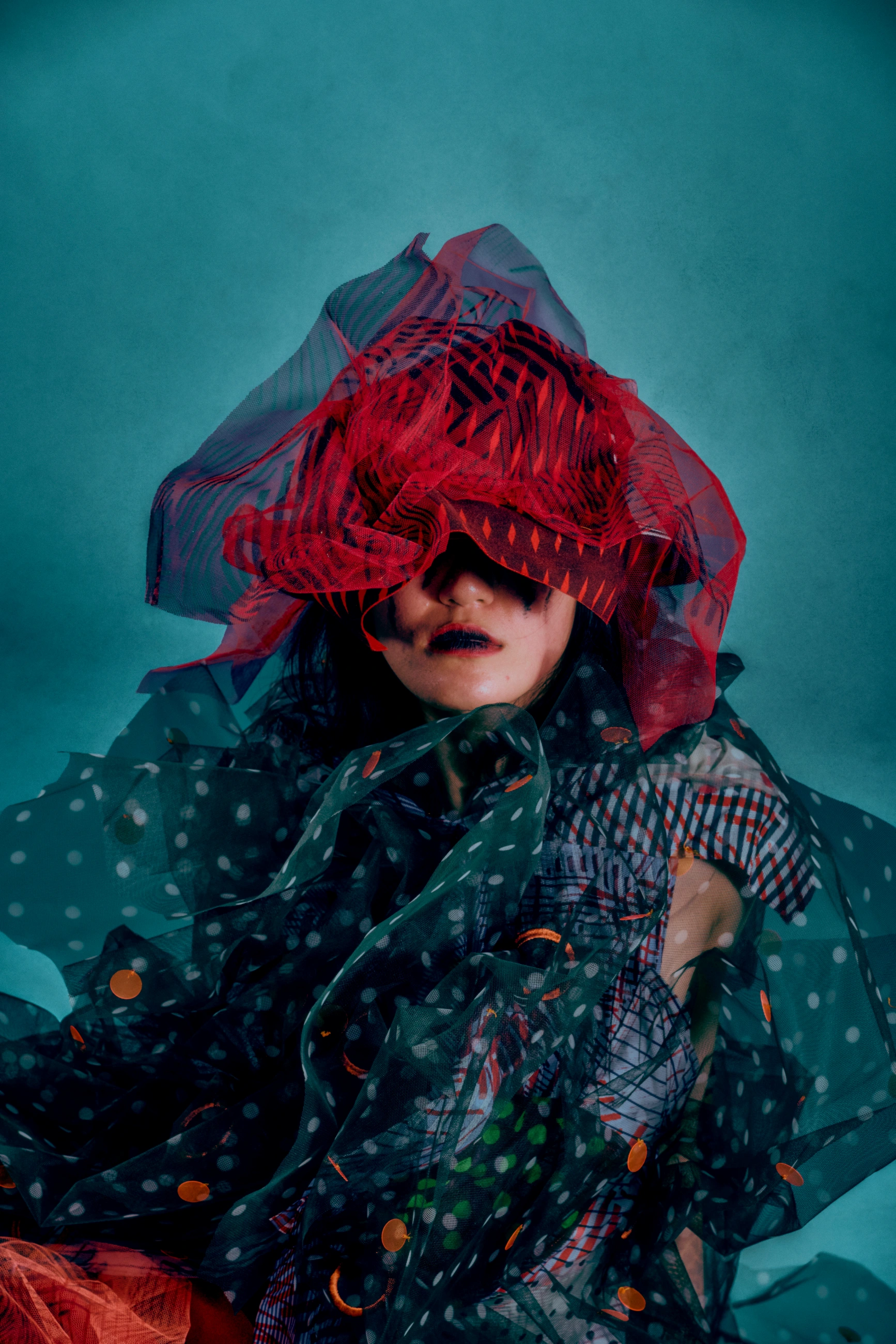
- The red veiled hats and the winged, structural pieces are some of the most arresting things in the lookbook. Is there one look you keep returning to as the heart of the collection, and why that one?
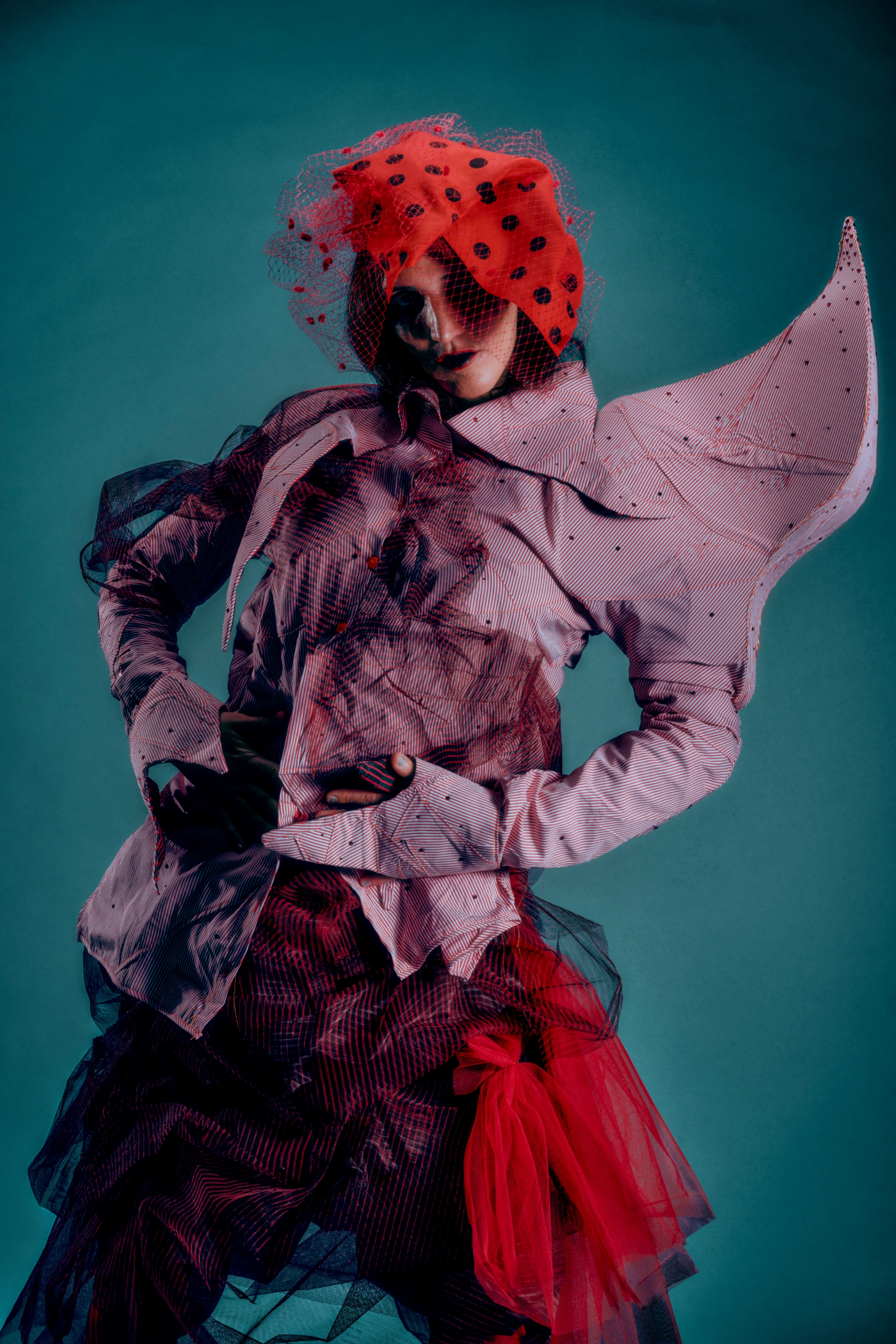
I have a couple of favourite looks from the collection, but I actually keep returning to Look 1. I tried something slightly different with this look by making it entirely red, which I think gives it a very strong first impression. I really love how the shirt textile and sculptural shoulder piece came together, but I think my favourite part is how much more there is to discover when you look closely.
The skirt is made from different layers of mesh and tulle that I screen-printed and layered together, so the different prints and details gradually reveal themselves rather than being immediately obvious. I think that relates quite closely to the collection as a whole; from a distance, you might not fully recognise what's going on, but the closer you look, the more layers, distortions and unexpected details you begin to notice.
- Sustainability is central to the practice, but the clothes are loud rather than quiet or worthy. How do you think about the relationship between working with deadstock and making something this maximal?
I don’t see those things as contradictory. I don’t think sustainable fashion needs to have a particular visual language, and I definitely don’t think it has to be minimal or neutral, even though that aesthetic is often associated with sustainability. I want to make clothes that are bold, expressive and experimental while still being conscious of the materials I use and the processes behind them.
In some ways, working with deadstock and upcycled materials actually contributes to that maximalism. I’m working with materials that already exist, often in limited quantities, so I have to combine things and respond to what I find rather than specifying the perfect new fabric for a design. Those restrictions can create unexpected clashes, textures and combinations that I might never have arrived at otherwise. I like sustainability functioning as an active part of the design process rather than dictating what the finished clothes are supposed to look like.
- You’re launching your own label now. What do you want it to stand for that you felt was missing elsewhere, and what are you most nervous about?
What I want to build is a label where experimentation, sustainability and inclusivity aren’t treated as separate selling points, but are embedded in the way the clothes are designed. I want to challenge the idea that sustainable fashion has to be minimal or understated and instead create something bold, maximalist and expressive while still being conscious of its impact.
I want to continue working primarily with deadstock, recycled, second-hand and upcycled materials, creating pieces in London and developing my own hand-drawn and screen-printed textiles. I’m particularly interested in unconventional combinations of materials and allowing the limitations and histories of existing fabrics to become part of the design process. I also want each collection to have a strong narrative behind it, so that the clothes communicate an idea or feeling and can create an emotional connection beyond simply being something to wear.
Inclusivity is also really important to what I want the label to become. I don’t want to design around one fixed idea of a wearer, or necessarily categorise clothes through traditional ideas of gender. I want to explore non-binary and increasingly size-inclusive approaches to design.
What I’m most nervous about is figuring out how to preserve that level of experimentation while making the label viable. At CSM, I could spend an enormous amount of time developing a textile or solving one garment, whereas running a label means having to think about so many other things as well. I don’t want the practical side of running a business to flatten the things that make my work interesting.
Coming from a working-class background, having access to the facilities, equipment and workspaces at university was essential to the way I developed my work. Now that I’ve graduated, I’m very aware of how expensive it can be to access those same resources independently. I think what I’m most nervous about is losing some of that freedom to experiment, or feeling that I can’t fully realise an idea because I don’t have access to the resources it requires. At the same time, working within limitations has always been part of my process, so I’m learning to find new ways of making and experimenting outside of university.
Goundry is now building that label in London on the same terms as the collection: deadstock, secondhand and upcycled material, hand-drawn textiles screen-printed by her, and garments designed without a fixed idea of who wears them or a default assumption about gender or size. The pressure she anticipates is practical rather than creative. Having come through CSM from a working-class background, the facilities and workspaces she relied on as a student are expensive to replicate independently, and losing that room to experiment is the thing she returns to when asked what worries her. She is clear-eyed about it. "Working within limitations has always been part of my process," she says, "so I'm learning to find new ways of making and experimenting outside of university."